Time blindness: when an hour is simply gone
Many adults with ADHD know the hour that vanishes and the deadline that is far away until it’s tomorrow. What time blindness means, what research says about it, and strategies that make time visible instead of felt.
Three weeks beforeNothing to do yet
The day beforeEverything at once
In stepsEach with its own day
What time blindness means, and what it doesn’t
You sit down to answer one email, and when you look up, half the afternoon is gone. You know the appointment is at three. You’ve known all week. And still you leave at 2:55 for a 20-minute drive. Many adults with ADHD know this pattern well enough to have a name for it: time blindness.
The term describes a persistent difficulty sensing how quickly time passes and managing it. Psychology Today is clear that it is not a diagnosable condition and does not appear in the DSM, the manual clinicians use for diagnosis. It is an everyday word for an everyday experience. CHADD’s Attention magazine breaks it into three parts: judging how much time has passed or is left before something, recalling the order in which things happened, and repeating something for as long as it took the last time.
What it isn’t:
- Not a lack of caring. People with time blindness are often painfully aware of running late. Knowing the time and feeling it are two different things.
- Not a missing clock. The clock is usually right there. Nothing prompts you to look at it, or the number doesn’t feel like it means anything yet.
- Not only ADHD, and not everyone with ADHD. Psychology Today also links it with autism, anxiety, depression and brain injury. And plenty of people with ADHD are reliably on time.
- Not a test result. A 2023 review notes that there is still no validated, standardised way to assess time perception (Mette, 2023). This guide doesn’t offer a test either.
Where the term comes from
The phrase is closely tied to psychologist Russell Barkley, who has researched ADHD for decades. Understood, a US nonprofit, credits him with coining it, and Psychology Today quotes him as saying that “ADHD is, at its heart, a disorder of time blindness.” Understood also describes his related image of temporal myopia: nearsightedness for time. The further away something is, the blurrier it gets.
The research is more careful than social media. In a study of 104 young adults with ADHD and 64 without, Barkley and colleagues asked people to reproduce short time spans, from 12 to 60 seconds. The ADHD group reproduced some of the spans as shorter and made more errors, and those differences held after accounting for IQ, depression and anxiety (Barkley et al., 2001). A 2023 review found only nine studies on time perception in adults with ADHD from the previous decade. Most found problems with estimating, reproducing or managing time, some found no clear link, and the author calls the research on adults scarce (Mette, 2023).
It also helps to know that misjudging time is human. In a classic study, honours students predicted they would hand in their thesis in about 34 days. On average they took about 55, and fewer than half finished even by the date they had given for “if everything went as poorly as it possibly could” (Buehler et al., 1994). With ADHD, the same slip may simply happen more often and with less warning. That makes it a reason to plan differently, not a flaw in you.
Typical situations
Time blindness rarely looks like “I didn’t know what time it was.” It looks more like this:
- The five minutes that weren’t. One more thing before you leave, and the one thing takes 25 minutes.
- Now or not now. A deadline in three weeks feels like no deadline at all. Then it’s Thursday, and it’s due tomorrow.
- Waiting mode. An appointment at four, and the whole day before it feels taken. You don’t start anything in case you lose track, and then nothing gets done.
- Leaving takes longer than getting there. You planned the 20-minute drive, but not the shoes, the keys, the search for the keys and the parking.
- Far too early, too. Understood notes that time blindness can make you late often, or even too early. Arriving 40 minutes ahead “just in case” is the same problem from the other side.
- Forgetting how long it took. Last week the laundry took 90 minutes from machine to folded. This week your head says 20 again.
- Lost in something. When something holds your attention, the clock seems to stop, and the next thing you notice is that you’re hungry.
Time blindness strategies: put time outside your head
Most good advice comes down to one idea. If your sense of time is unreliable, stop consulting it. Move time out of your head and into the room, where you can see it, hear it and measure it. None of what follows needs an app.
Clocks where your eyes already are
Understood puts it plainly: put clocks everywhere, in the kitchen, on your wrist and in the car. The places that matter most are the ones where time tends to vanish: the bathroom, your desk, next to the sofa. An analogue clock has an advantage here, because it shows time as distance. You see that the hand has a quarter of the way to go before you need to leave, instead of reading 8:32 and doing sums. Visual timers, which CHADD lists among useful tools, do the same for a single task: the time left is a shrinking area, not a number.
Measure instead of guessing
Your estimate of how long something takes is a guess based on a feeling. A measurement is better. Time the things you do often, once, on an ordinary day: the shower, getting out of the door, the weekly shop, an hour of email that is never an hour. Write the minutes down where you will see them when you plan.
This works for a reason. In the planning fallacy studies, people’s estimates were too optimistic for all kinds of tasks, and in one experiment the bias disappeared when people were asked to connect their prediction to how long similar tasks had taken before (Buehler et al., 1994). A list of real durations is that past experience, written down so you don’t have to remember it.
Transitions instead of times
An appointment at three is a time. What you actually need to catch is the moment you have to stop what you’re doing: the transition. So set alarms for transitions, not just for events. Psychology Today suggests alarms for when to start getting ready and when to leave. Name each one after what happens next: “Shoes on”, “Close the laptop”, “Leave now”. A label tells you what to do. A bare time only tells you that you’re late.
Just the time
Transitions
The same idea works without a clock. Hang tasks on things that happen anyway: after the alarm, after lunch, when the dishwasher beeps. “After lunch” is easier to catch than “around 1:30”, because you don’t have to be watching the time to notice it.
Buffers you plan, not hope for
Buffer time is standard advice, and CHADD’s list goes further: double or triple your time estimates. The trick is to make the buffer part of the plan instead of a hope.
- Put the buffer at the start. Plan to arrive ten minutes early and bring something to do there, a book or one small task. Being early then costs nothing, and waiting mode has an end.
- Count the edges. Getting out of the door is a task of its own. Time it once and add it to every trip.
- Leave gaps between plans. Back-to-back appointments leave no room for the fact that things run long.
“Roughly then” instead of deadlines
Far-off deadlines are where temporal myopia hurts most: three weeks away is invisible, and the day before is panic. Two things help. Break a distant deadline into a few near steps, each with its own day. And give to-dos that have no real deadline a rough place in the week, like “Tuesday afternoon, about 30 minutes”.
A rough place is not a deadline. If Tuesday doesn’t happen, the to-do moves to Thursday. Nothing turns red, nothing is counted. That sounds soft, but it does what a deadline is meant to do: it brings the task into view now, while there is still time. And because a missed slot costs nothing, it’s easier to keep planning next week, too.
An end before you start
Anything that absorbs you has no natural end. Psychology Today suggests setting an alarm to end it before you begin, and keeping such things off days with important plans. Decide the end while you still have a sense of time: at the start, not in the middle.
Say it out loud
Time blindness affects other people, too, and that is often the hardest part. Understood suggests being honest about it and agreeing on practical fixes with the people around you, like sending a text when you leave the house. That turns “Where are you?” into information instead of an argument. It isn’t an excuse. It’s a plan you share.
A week you can see
Paper works well here: a whiteboard with the next seven days, a clock in every room, a timer on the counter. If you’d rather keep it on your phone, this is how Not Yet, built with ADHD in mind, handles time.
Week shows the next seven days, starting today: your routines and alarms, and, if you connect your calendar, appointments and birthdays (the calendar is part of Plus). You drop a to-do into a gap, and it gets a time, not a deadline: roughly then. When it’s time, a reminder shows the to-do’s icon. If it doesn’t happen, it fades at its time and leaves the day in the evening. It stays on your list, and nothing is marked overdue.
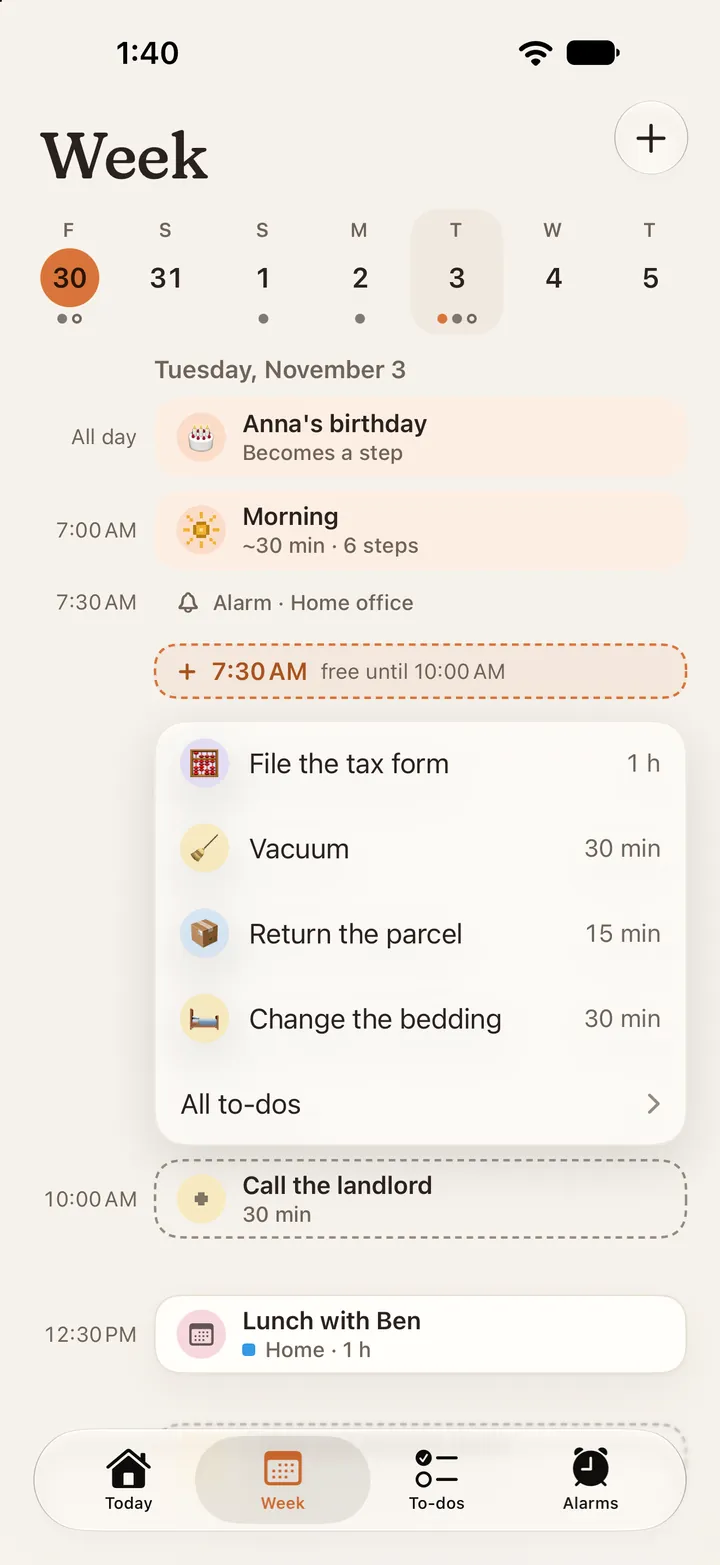
Mornings start with a transition instead of a time. The alarm rings even on silent, has no snooze and goes quiet only after a short task. If you pick a routine for after the alarm, it starts right away, and Week lists it as “After the alarm” instead of at a clock time. On the Lock Screen, the routine shows its current step with a Done button, and with Plus, a Focus lock you start for a set time shows how many minutes are left, so the time remaining is there whenever you glance at your phone. And when there’s a gap before something, a sidequest asks how much time you have and picks one to-do that fits. Tell it you have until three, and it keeps ten minutes for the transition: “Leave at 2:50”. For the first hour of the day, see an ADHD morning routine that lasts.
When to talk to a doctor
Time blindness is a description, not a diagnosis, and nothing in this guide is a test. If losing track of time keeps affecting your work, studies or relationships and you wonder whether ADHD is behind it, talk to a GP or your doctor. The NHS lists finding it hard to organise your time among the signs of ADHD in adults, and a GP can refer you for an assessment. If you already have a diagnosis, time is worth raising in treatment, too: the 2023 review argues that treatment of adult ADHD should pay more attention to problems with time perception (Mette, 2023). You don’t need a diagnosis to use anything here, and nothing here replaces one.
Sources
- Psychology Today: Time Blindness
- Understood, Sarah Greenberg: ADHD and “time blindness” (2023)
- CHADD, Attention magazine, Adam Ly: Time Unbound: Managing Time Blindness at Work (2024)
- Barkley, Murphy, Bush: Time perception and reproduction in young adults with attention deficit hyperactivity disorder. Neuropsychology 15(3) (2001)
- Mette: Time Perception in Adult ADHD: Findings from a Decade. A Review. International Journal of Environmental Research and Public Health 20(4) (2023)
- Buehler, Griffin, Ross: Exploring the “planning fallacy”: Why people underestimate their task completion times. Journal of Personality and Social Psychology 67(3) (1994)
- NHS: ADHD in adults (2025)
This guide shares everyday strategies. It is not medical advice and doesn’t replace a diagnosis or treatment. If something here sounds familiar, a doctor or therapist can help.