An ADHD to-do list that works with you, not against you
For anyone whose list keeps growing while the days keep going. Why long to-do lists stop working with ADHD, and how to make one that stays short, visible and kind to you on bad weeks.
Parking lotEverything, as messy as you like
- Dentist1
- Glasses
- Taxes2
- Learn Spanish someday
- Bathroom3
- Call Sam back
Gym membership- Bike tyre
- Plan the holiday
TodayThree next actions, each with a rough size
- 1Call the dentist at 95 min
- 2Put all receipts in one envelope15 min
- 3Buy a shower curtain on the way home20 min
Why long to-do lists stop working
It usually starts well. You write everything down on a Sunday, and for a day or two it feels like relief. By Wednesday the list has 34 lines. Some are tiny, some are whole projects, a few have been there since spring. You look at it, feel heavy, and do something else. The list is still right, but you stop opening it.
That isn’t a character flaw. Writing things down is a good idea with ADHD. A meta-analysis of 38 studies found that working memory difficulties, holding things in mind while you use them, persist into adulthood for many people with ADHD. The NHS lists “being easily distracted or forgetful” and “finding it hard to organise your time” among the signs in adults. A list outside your head takes some of that load.
The trouble starts when the list only stores and never decides. Three things go wrong with long lists:
- Everything looks the same. “Call the dentist” and “sort out the tax return” sit in the same font, so your brain has to rank 34 items before it can start one. That ranking is the hard part.
- Projects hide as tasks. “Bathroom” isn’t something you can do. It’s twelve things, and none of them is written down.
- The list becomes a scoreboard. Old items are a daily reminder of what you didn’t manage. Many people with ADHD know the feeling of opening a list and closing it again just to avoid that.
There is also a reason why writing something down doesn’t always calm your mind. In experiments by E. J. Masicampo and Roy Baumeister, unfinished goals kept popping up in people’s thoughts and got in the way of other tasks. What made those intrusions go away wasn’t finishing the goal. It was making a specific plan for it. The study wasn’t about ADHD, but the point travels: a line that says what you’ll do, and roughly when, lets your head let go. A vague line doesn’t.
Two lists: a parking lot and today
The US ADHD organisation CHADD suggests keeping a larger list of every task that comes to mind, and moving items from there to your action list once a day or every couple of days. That split solves most of the problems above.
- The parking lot takes everything, as messy as you like. Ideas, errands, “someday” things. You don’t work from it. It just means nothing gets lost.
- Today is short. CHADD suggests choosing the three most important things and numbering them. If you like more structure, try 1-3-5, also from CHADD: one big thing, three medium, five small. If you rarely finish your list, make the next one smaller, not stricter.
Daily things like brushing your teeth or emptying the dishwasher don’t belong on either list. They belong in a routine, where they don’t compete with one-off tasks. If mornings are where it all starts to slide, the ADHD morning routine guide covers that part.
Write the next action, not the project
CHADD’s advice is to “focus on specific actions you can take, rather than vague ideas.” In practice, every line on today’s list should start with a verb and be something you could do in one sitting.
- Not “Dentist”, but “Call the dentist at 9 and ask for a check-up.”
- Not “Bathroom”, but “Buy a new shower curtain on the way home.”
- Not “Taxes”, but “Put all receipts in one envelope.”
Breaking overwhelming tasks into steps is also part of how therapists teach organisation. In a randomised trial of 86 adults with ADHD whose symptoms persisted despite medication, cognitive behavioural therapy that started with a calendar and task list system and “breaking down overwhelming tasks into steps” helped more than relaxation training with education. The list was one part of a full therapy, so this doesn’t mean a list alone treats anything. It does show the skill is worth learning.
One more thing helps with ADHD: add a rough size. “15 min”, “30 min”, “1 h”. When you have twenty minutes before you need to leave, you can pick something that fits instead of starting something that won’t.
Put it where your eyes already are
“The key to a successful to-do list is keeping it somewhere you’ll see and use it,” CHADD writes. With ADHD, out of sight is often out of mind, so a list in a notebook in a drawer may as well not exist.
- A sticky note on your laptop or monitor, one per day.
- A small whiteboard by the door you wipe every evening.
- On your phone, the Lock Screen or a widget, so you don’t have to open an app to see it. Opening an app is often where the evening goes.
Visible also means short. Three lines on a sticky note get read. A scrolling list of forty doesn’t.
Things that come back, without a backlog
Some tasks are never really done. Vacuuming, fresh bedding, descaling the kettle, the yearly dentist check-up. Most list systems handle them badly: either they’re forgotten, or they repeat on a fixed day and pile up. Miss vacuuming three Saturdays in a row and some apps show three overdue copies. Now a ten-minute chore feels like a debt.
A kinder way to handle repeating tasks has two rules:
- Count from the last time you did it. “Every two weeks” means two weeks after you actually vacuumed, not every second Saturday. Late once? The next one simply moves. There’s nothing to catch up on.
- Only ever one copy. A task that comes back shows up once, however long it’s been. For things with a real date, like a contract renewal, let it show up a few days ahead instead.
Vacuum, every two weeks
Today
On a fixed day3 overdue
From the last timeJust one
On paper, write repeating tasks on a separate card with the rhythm next to them, and the date you last did each one. Glance at it once a week and copy over what’s due.
This matters for more than tidiness. In a study of first-year students across two rounds of exams, those who forgave themselves for procrastinating before the first exams felt less negative afterwards and procrastinated less before the second, as the British Psychological Society’s Research Digest reported. A list that greets you with a pile of overdue chores makes that harder.
No red numbers
A badge that says “12 overdue” in red tells you nothing you can act on. It doesn’t say which one matters, or what to do first. It just makes the list harder to open.
Old items still deserve a look, just not a red one. CHADD suggests asking why a task keeps getting carried over. Usually it’s one of three things:
- Too big. Split it until the first step is obvious, and put only that step on today’s list.
- Dreaded. CHADD suggests a reward for after. Pairing it with something you like, a podcast or a coffee, can help too.
- Not needed anymore. Delete it. CHADD says the same: some tasks lose their importance. Crossing something off because it no longer matters counts.
If you use an app, look for one that doesn’t count against you. If yours does, turn off the badge.
“Roughly then” instead of deadlines
Real deadlines, like a rent payment or a form due on the 30th, go in your calendar. They’re few, and they deserve to be firm.
Everything else does better with a rough plan than a deadline. Psychologists call it an implementation intention: deciding in advance when and where you’ll do something. Across 94 tests, Peter Gollwitzer and Paschal Sheeran found a medium-to-large effect on actually reaching goals. It helped people get started and stay on track when distractions came up.
So instead of “Order new glasses (by Friday!)”, try “Order new glasses, Thursday after lunch.” If Thursday after lunch comes and goes, nothing turns red. The task goes back to your list as it was, and you give it another spot. A rough slot is an invitation, not a promise you broke.
Look at the week, not just today. Find the free gaps, the hour between a meeting and picking someone up, the quiet Sunday morning, and drop one task into each. Leave the rest of the gaps empty. Free time is part of the plan too.
How to make an ADHD to-do list in ten minutes
- Write everything on your mind onto one page: your parking lot.
- Cross out what doesn’t matter anymore.
- Move the repeating chores to their own card, with a rhythm and the date you last did them.
- Pick three things for today and rewrite each as a next action with a verb.
- Add a rough size to each: 15 min, 30 min, 1 h.
- Give one of them a rough slot, like “after lunch.” Put real deadlines in your calendar.
- Put today’s list where you’ll see it without looking for it.
- Tomorrow, start a new short list. Anything left over goes back to the parking lot, not onto a pile.
An iPhone to-do list that stays quiet
Paper does all of this well. If you’d rather keep your list on your phone, that’s what we had in mind when we built the to-dos in Not Yet, an iPhone app made with ADHD in mind:
- Check off without opening the app. The large widget shows the rest of your day and up to two open to-dos under it. Tap the circle and it’s done.
- Coming back. Any to-do can repeat, either a while after you last did it or on a fixed date, showing up a few days ahead. There’s only ever one copy, at most three come back on the same day, and the rest wait for the next days.
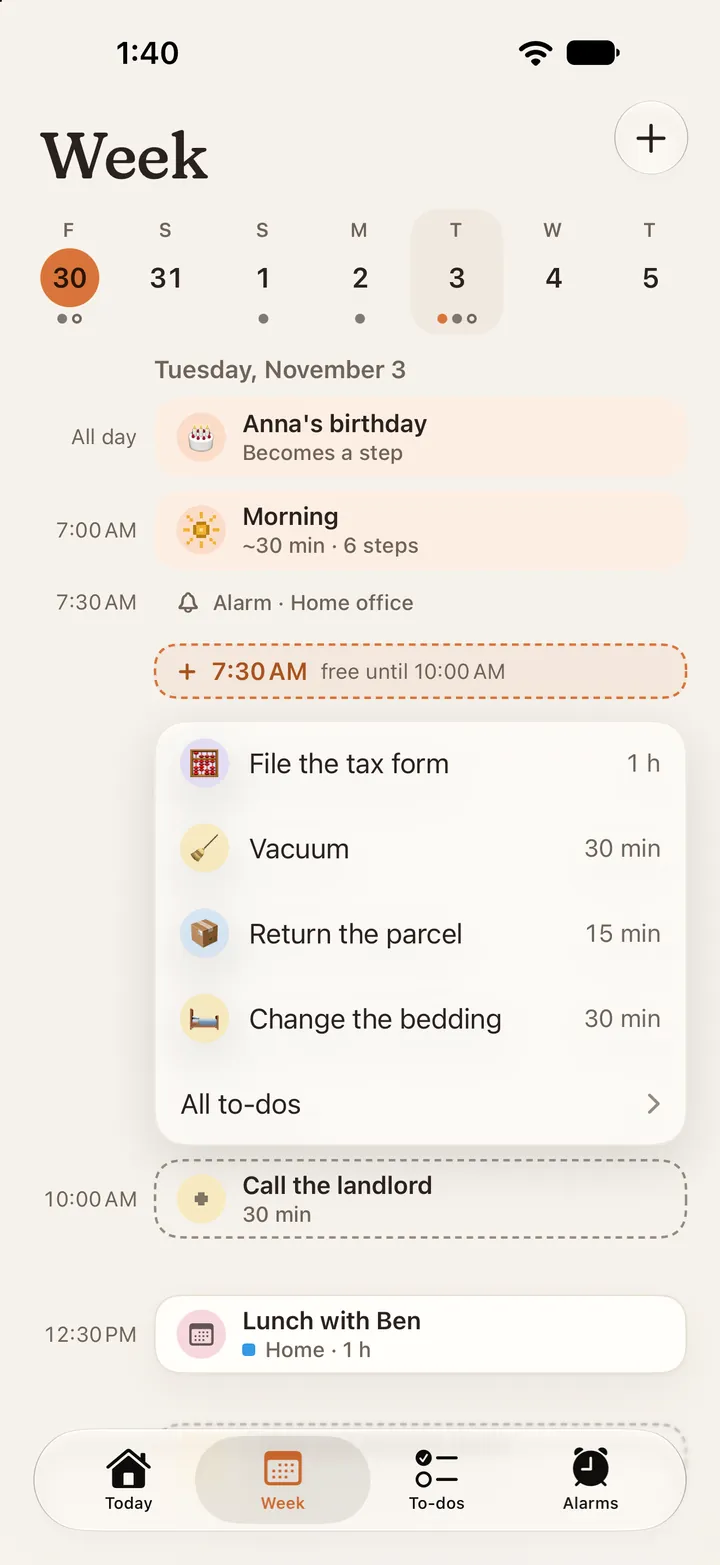
- Roughly then. In the Week you see the next seven days with your routines and alarms, and with Plus your appointments and birthdays too. Drop a to-do into a free spot and you get a reminder when it starts. If the time passes, it fades quietly and stays on your list as before.
- Nothing turns red. No overdue counter, no streak to lose. To-dos, the widget, Coming back and planning in the Week work without paying.
The daily things go in routines, which play a little differently each time, so your to-do list is left with the one-off tasks it’s good at.
When the list isn’t the problem
A better list helps with the everyday. It can’t carry everything. If you’re constantly behind despite trying hard, if forgetting things is affecting your work, studies or relationships, or if you think you might have ADHD, talk to your GP or doctor. The NHS notes they can discuss support and may refer you for an assessment. Therapy for adult ADHD often includes exactly these skills, with someone to help you practise them. You don’t need a diagnosis to use anything here, and nothing here replaces one.
Sources
- NHS: Attention deficit hyperactivity disorder (ADHD) in adults (reviewed 2025)
- Alderson, Kasper, Hudec, Patros, Neuropsychology: Attention-deficit/hyperactivity disorder (ADHD) and working memory in adults: a meta-analytic review (2013)
- Masicampo, Baumeister, Journal of Personality and Social Psychology: Consider it done! Plan making can eliminate the cognitive effects of unfulfilled goals (2011)
- CHADD: Time Management and ADHD: To-Do Lists
- CHADD ADHD Weekly: The Art of the To-Do List (2022)
- Safren et al., JAMA: Cognitive Behavioral Therapy vs Relaxation With Educational Support for Medication-Treated Adults With ADHD and Persistent Symptoms: A Randomized Controlled Trial (2010)
- British Psychological Society Research Digest: The cure for procrastination? Forgive yourself!, on Wohl, Pychyl, Bennett, Personality and Individual Differences (2010)
- Gollwitzer, Sheeran, Advances in Experimental Social Psychology: Implementation intentions and goal achievement: a meta-analysis of effects and processes (2006)
This guide shares everyday strategies. It is not medical advice and doesn’t replace a diagnosis or treatment. If something here sounds familiar, a doctor or therapist can help.