Why routines get boring with ADHD, and how to keep one anyway
For anyone whose new routine works for ten days and then quietly stops. What research says about ADHD and boredom, and five ways to keep the steps while changing the game.
Your steps stay
- 1Water
- 2Bathroom
- 3Dress
- 4Eat
- 5Out
-
Wheel
A wheel picks the next step.
-
Dice order
Dice set the order.
-
Card draw
Draw the next step from the pile.
-
Boss fight
The longest step is the boss and comes last.
The ten-day routine problem
You set it up on a Sunday evening. Get up, glass of water, shower, get dressed, breakfast, out the door. The first mornings feel good, almost easy. Around day eight it feels like a chore. Around day ten you skip it once, then twice. By the end of the month, the routine is a note on your phone you don’t open anymore.
If that sounds familiar, you’re not lazy, and you’re not alone. The steps didn’t stop making sense. They stopped being new.
The usual advice is to push through until it becomes a habit. This guide takes another route: keep the steps, and change how they play.
Does routine help with ADHD at all?
Yes. Structure is one of the most common recommendations. The NHS lists “finding it hard to organise your time” among the signs of ADHD in adults, and suggests asking for help with planning and structuring tasks at work. The ADHD organisation CHADD suggests breaking long tasks into shorter ones and setting a timer to stay on task.
So the problem is rarely the idea of a routine. It’s keeping one alive once it stops being interesting.
Novelty wears off. That’s not a character flaw.
Boredom in ADHD has been studied for years, and the findings point the same way. In a 2025 study in the Journal of Attention Disorders, young adults with ADHD traits reported far more boredom proneness than peers without them, a very large difference. Attention control and working memory explained part of it, but only a small part. The study was small, 31 people with ADHD traits and 57 without, so read it as a strong hint rather than the final word.
An earlier study from the University of Waterloo found that people who get bored easily also report more symptoms of adult ADHD. It describes one kind of boredom as “agitated”: you want to do something meaningful, but what you try doesn’t satisfy. That’s a fair description of day ten.
A 2020 study is often quoted as showing a “strong” link between ADHD and boredom. It looked at 30 children and teenagers and found a moderate correlation between ADHD severity and boredom proneness. Useful, but not about adults, and not as strong as it’s sometimes made to sound.
Then there’s timing. A meta-analysis of 37 comparisons with 3,763 participants found that people with ADHD chose a small reward now over a larger one later more often than people without ADHD. The effects were small to medium. A routine pays off in weeks: more rested, a tidier home, on time more often. That’s a reward later. The boredom happens right now.
Put together: a routine that’s identical every day loses what carried it at the start, which was being new. That says nothing about your character. It says the routine needs a different fuel.
One more finding, not about ADHD, but encouraging. In a six-week experiment with 121 inactive students, the group whose exercise plan had more variety stuck to it better than the group with a repetitive one. Variety isn’t a gimmick. It can be part of what keeps you going.
Why streaks backfire
Streak counters are everywhere because they work, for a while. In a series of seven studies, Silverman and Barasch found that people who saw an intact streak in their log did more of the behaviour afterwards than people who saw a broken one, even when what they had actually done was the same. Keeping the streak becomes a goal of its own. The effect was stronger when people blamed themselves for the break.
That last part matters with ADHD. Some days go sideways: a bad night, an early appointment, a morning that just won’t start. With a streak, one of those days turns 23 into 0, and the counter makes it look like your fault. Often that’s the moment a routine ends. Not because it stopped helping, but because the number now feels like a verdict.
Same steps, different game: 5 ways to vary a routine
The idea is to separate two things. The steps are what needs doing, and they stay. The game is the order, the form and the setting, and that changes. You don’t need an app for any of this. A die, a few slips of paper and your music are enough.
One thing should stay fixed: the moment your routine starts. Habits grow around a stable cue, like “after breakfast” or “after the alarm”. Keep that anchor, and vary what happens after it.
1. Roll a die for the order
Number your steps from one to six. Before each step, roll and do the one that comes up. If it’s already done, take the next open one. It sounds a little silly, and that’s the point: a moment of chance before each step turns a familiar list into a round of something. With more than six steps, group the short ones.
2. Save the hardest step for last
The classic advice is to do the hardest thing first. That works if starting is easy for you. If starting is the hard part, flip it. Make the step you dread, the longest or the dullest, the finale. Every other step becomes a warm-up for it, and by the time you get there, you’re already moving.
3. Draw cards
Write each step on a card or a slip of paper. Shuffle, draw, do what it says, put it aside. Now and then, add a joker that reads “Skip one step today.” A pile of cards gives you something to hold and something to finish: you can watch it shrink.
4. Change the soundtrack or the setting
Same steps, new frame. A different playlist each week, a podcast you only play during this routine, one song per step. CHADD notes that for many people with ADHD, music helps with tasks that feel boring. If a step allows it, move it: stretch by the window instead of next to the bed, read in another chair. Keep the starting cue, change the scenery inside it.
5. Have a short version for bad days
Decide today what the routine looks like on a bad day: half the steps, or just the two that matter most. Write it down. On a rough morning you don’t have to choose between all of it and nothing. You do the short version, and it counts.
Rotate these games. Dice for a few days, then cards, then the hardest step last. Switch before one gets old, not after.
- Write each step on its own card.
- Pick the cue that starts your routine, and keep it the same every day.
- Choose a game for the next few days: dice, cards or hardest step last.
- Write your short version for bad days on the back of the first card.
- When the game starts to feel familiar, switch to another.
- Count every time you did the routine, all of it or part of it. Don’t count the gaps.
Runs count. Gaps don’t.
Replace the streak with a count. Not days in a row, just the number of times you did the routine. Call each one a run. Run 24 is still run 24 after a week off. Nothing resets, and nothing turns red.
Streak3
Runs26
Habit research is kinder than a streak counter, too. In a well-known study of how habits form in everyday life, missing a single opportunity “did not materially affect the habit formation process.” The same study found that it took between 18 and 254 days for a new behaviour to become as automatic as it was going to get. Ten days was never the finish line.
A partial run counts as well. Three of six steps on a hard morning are three more than none.
Tools that do the varying for you
All of this works by hand. It also takes a bit of setup every few days, and with ADHD, the setup is often the part that slips. That’s why we built Not Yet, an iPhone and Apple Watch app built with ADHD in mind. Its routines follow the same idea: your steps stay, and the app changes the game around them.
- The game changes every few runs. Wheel, Dice order, Card draw, Countdown, Blind run or Boss fight, where your longest step is the boss and comes last. It never goes back to one of the last two. Don’t like today’s game? Reroll it.
- So does checking off. Stamp the card, tear the ticket, pop a bubble, or hold until the rocket lifts off. Now and then, a small surprise turns up along the way, like a scratch card.
- A short version is built in. A twist like “Only half” parks about half the steps (pinned ones always stay), and that counts as all of it. After a longer break, your first run is a short one, with no word about the pause.
- No streaks. Each run has a number, and “Some of it” counts. Steps earn coins, and at the end of the run they sit in a piggy bank you get to smash.
- No app to open. Start a run and check off steps on the Lock Screen or in a widget, and with Plus on your Apple Watch.
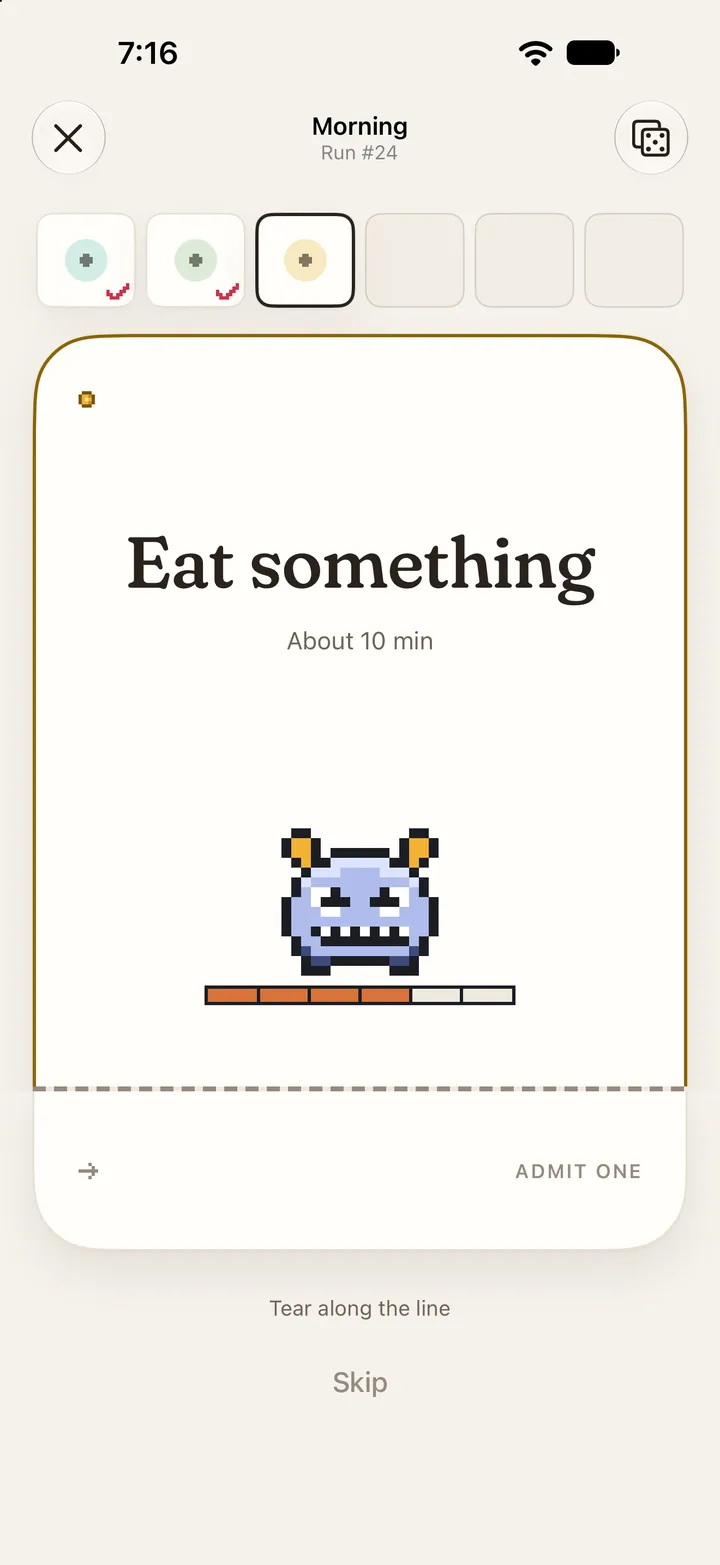
You can see the rotation on the routines page. If mornings are your hardest stretch, the guide to an ADHD morning routine goes into the first hour in detail. And the Not Yet home page shows the rest: the alarm, the app locks and the week.
Whichever way you do it, by hand or with an app, the goal is the same: the steps you need, in a form your head still finds worth showing up for.
Sources
- NHS: Attention deficit hyperactivity disorder (ADHD) in adults (reviewed 2025)
- CHADD: Workplace Issues
- CHADD: Tune In To Focus
- Journal of Attention Disorders: Orban et al., Why Are Individuals With ADHD More Prone to Boredom? (2025)
- Experimental Brain Research: Malkovsky et al., Exploring the relationship between boredom and sustained attention (2012)
- Journal of Child and Adolescent Psychopharmacology: Golubchik et al., Levels of Proneness to Boredom in Children with ADHD On and Off Methylphenidate Treatment (2020)
- Journal of Attention Disorders: Marx et al., ADHD and the Choice of Small Immediate Over Larger Delayed Rewards: A Comparative Meta-Analysis (2021)
- Journal of Behavioral Medicine: Sylvester et al., Variety support and exercise adherence behavior (2016)
- Journal of Consumer Research: Silverman and Barasch, On or Off Track: How (Broken) Streaks Affect Consumer Decisions (2023)
- European Journal of Social Psychology: Lally et al., How are habits formed: Modelling habit formation in the real world (2010)
This guide shares everyday strategies. It is not medical advice and doesn’t replace a diagnosis or treatment. If something here sounds familiar, a doctor or therapist can help.