When the day won’t end: how to stop scrolling in bed
For anyone who plans to sleep at 23:00 and looks up at 1:40. What’s behind it, why ADHD can make it harder, and what helps when your willpower is already spent.
Bedtime
Without an end
With an end
Why the day doesn’t end
You’re tired. You know you should sleep. You open one app to check one thing, and an hour later you’re still there. The next morning starts tired, and that evening it happens again.
If this sounds familiar, the problem usually isn’t going to bed. It’s stopping. The psychologists who first studied the pattern suspected that it is “not so much a matter of not wanting to sleep, but rather of not wanting to quit other activities.” A feed never reaches an end, so it never hands you a natural place to stop.
The rest of your day plays a part too. In a study of 218 adults, people who had tried to resist more urges during the day reported more bedtime procrastination that night. The effect was modest, but it fits what many people feel: after a demanding day, there’s little left for one more “no.”
And for many people, the scrolling starts after they’re already lying down. In a survey of 400 secondary school students, most said they procrastinated in bed rather than before it, with messages and videos at the top of the list. You go to bed on time, and sleep still comes late.
Revenge bedtime procrastination, briefly
Bedtime procrastination was introduced as a research topic in 2014 by a team at Utrecht University. Their definition: failing to go to bed at the time you intended, when nothing outside you prevents it. In their survey of 177 adults, more bedtime procrastination went with less sleep, more feelings of not sleeping enough, and more tiredness during the day. The study was a one-time survey, so it shows a link, not a cause.
The “revenge” part came later. It translates a Chinese expression, 報復性熬夜, roughly “retaliatory staying up late.” It spread in English in June 2020, after the journalist Daphne K. Lee shared it on Twitter. The Sleep Foundation describes the original phrase as reflecting frustration with long, stressful working hours. The idea: when the day belongs to work and to other people, the night is the only time that feels like yours, even if you pay for it with sleep.
The Sleep Foundation names three parts: a delay that cuts into your sleep, no good reason for it, such as an emergency or a night shift, and knowing that it will probably cost you. If you nodded at all three, you’re in good company.
Why it may be more common with ADHD
The research here is young, so read this as “there are signs,” not as settled fact.
- A direct link in one study. In 2023, researchers surveyed 553 university students. Those who screened positive for likely ADHD reported more bedtime procrastination and fewer hours of sleep. The connection was small, and the sample was students, but it fits with the findings below.
- A later body clock. A systematic review of 62 studies found that ADHD is associated with “more eveningness/later chronotype” and with a delayed internal clock. If your body thinks it’s earlier than it is, 23:00 can feel like the middle of the evening.
- Time that slips away. The NHS lists “finding it hard to organise your time” among the signs of ADHD in adults. Many people with ADHD describe looking up from a feed and not knowing where the hour went. Lab research on time perception in adult ADHD is still thin and mixed, but the everyday experience is common.
Put together, an evening with no clear end is hard for most people, and often harder with ADHD. That’s not a character flaw. It’s a reason to build the end into the evening instead of expecting to find it at 1:00.
How to stop scrolling at night: give the evening an ending
A day needs an end you can see. A bedtime alone is a number, and numbers are easy to scroll past. A wind-down is a stretch of time with a shape.
- Start it at a fixed time. For example, an hour before bed. The NHS suggests relaxing for at least an hour before bed and trying not to use phones, tablets or computers during that hour.
- Keep it short and the same. Phone on the charger, tomorrow’s clothes out, teeth, lights down. Four steps you don’t have to think about are better than ten you have to plan.
- Close the day on paper. Write down what’s still open for tomorrow. Then it doesn’t have to circle in your head, or send you back to your phone “just to check.”
- Pick something to do instead. A paper book, a podcast with the screen off, a shower, stretching. “No phone” alone leaves a gap. Something to do fills it.
Move the decision earlier
At 0:30, with the phone in your hand, you’re the person least able to decide to put it down. So don’t leave the decision to that person.
The researchers behind the 2014 study expected strategies that don’t require effort to work best, because the problem shows up exactly when self-control is low. One of the tools they named is the implementation intention: a plan in the form “When X happens, I do Y.” For example:
- “When I plug in my phone, I go brush my teeth.”
- “When the wind-down starts, the phone goes to the hallway.”
- “When I catch myself on a second video in bed, I put the phone face down on the floor.”
Decide the rest in daylight too: a bedtime for each kind of day, workdays and weekends, and a wake-up time that stays fairly steady. The NHS recommends waking up and getting out of bed at the same time every day. A steady morning also makes the evening easier to plan.
Put the phone out of reach, and get a real alarm clock
Distance does what willpower can’t. If the phone is within arm’s length, “one more minute” is always a reach away.
In a survey of 844 adults in Belgium, six out of ten took their mobile phone to the bedroom. Texting and calls after lights out went with worse sleep quality, and bedtime phone use went with more tiredness, and among younger adults with later rising times. Again a link, not proof, but it matches what many people notice.
- Charge it outside the bedroom. The hallway, the kitchen, the desk. If that’s too much at first, charge it across the room, out of reach of the bed.
- Get a simple alarm clock. Many people keep the phone in bed because it’s their alarm. A basic alarm clock takes that reason away, and checking the time no longer means looking at your notifications.
- If it has to stay close: the NHS suggests silent mode and placing the phone face down to reduce light. Better than nothing, though out of reach is better still.
If getting up is the harder half of your day, read our guide to waking up when your alarm doesn’t.
Make time for yourself before night
Revenge bedtime procrastination is often a reasonable wish at the wrong hour. If the evening feels like the only time that belongs to you, more discipline at night won’t fix it. More time of your own earlier will.
- Put it on the calendar. Twenty or thirty minutes after work that are just yours: a walk, a game, a show, nothing at all. Planned, not left over.
- Plan lighter evenings after heavy days. If a day asked a lot of you, that evening is when you’re most likely to stay up. Expect it, and keep that evening simple.
- Let the feed have a time slot. If you enjoy it, give it a place in the day, after dinner for example, instead of letting it fill the night.
If you’re awake anyway
Some nights you go to bed on time and still lie awake. That’s exactly when the phone is most tempting, and least helpful.
The NHS advice: if you’re still awake after around 20 minutes, get up and sit somewhere comfortable. Do something relaxing, like gentle yoga, reading a book or listening to quiet music. Go back to bed when you feel sleepy. Leave the phone where it is.
And the next morning: get up at your usual time, even after a short night. The NHS advises against sleeping in after a bad night: stick to your regular hours instead. One late night doesn’t ruin anything. Tonight is a new attempt.
The strongest lever: apps that stay locked until you’re up
All the steps above work better when the phone doesn’t argue back. That’s the idea behind a bedtime app lock: you decide once, in daylight, and when the moment comes, the app simply doesn’t open. There’s nothing to negotiate at 0:30.
We built Not Yet with ADHD in mind, and this is how its Nights work:
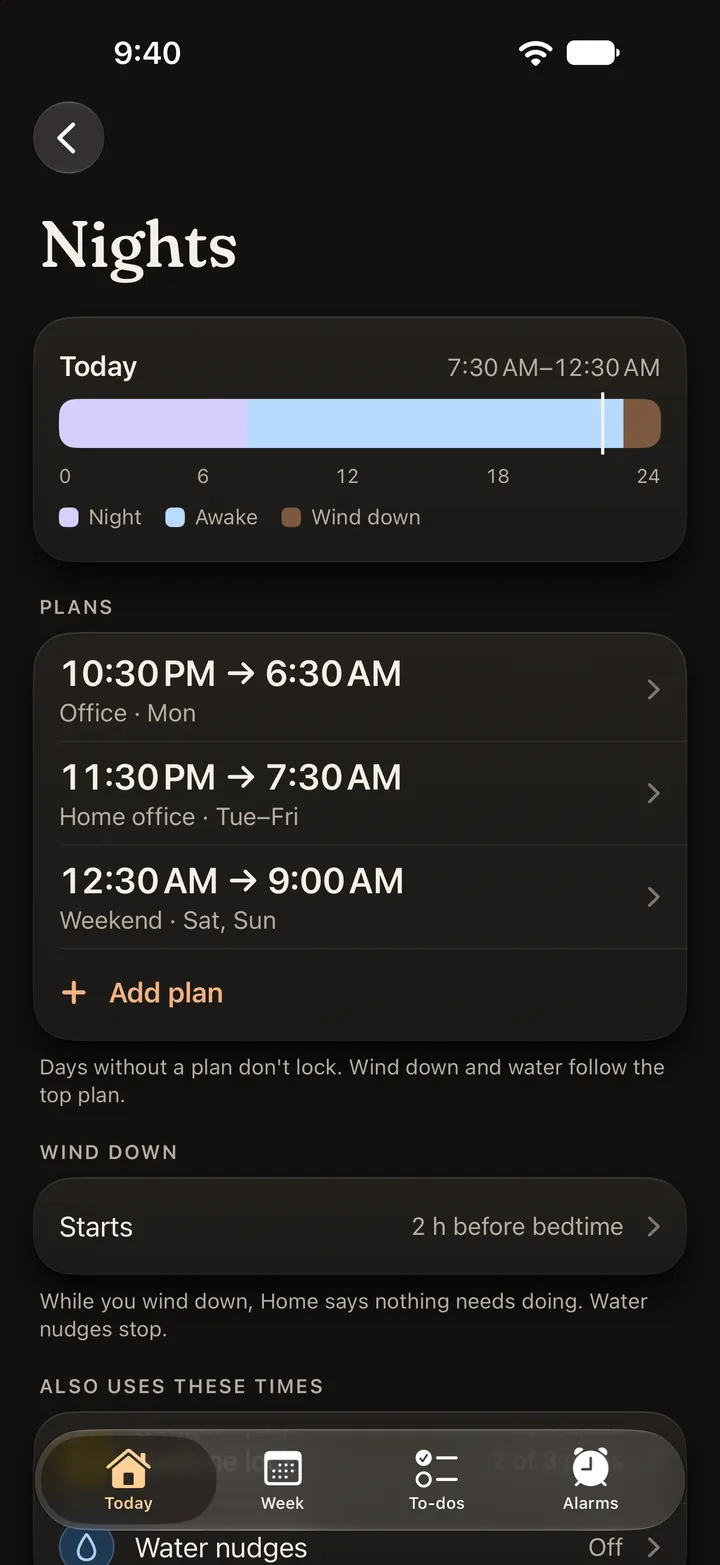
- A plan for each kind of day. Office days, home days, the weekend, each with its own bedtime and wake-up time.
- Wind-down first. It starts 30 minutes to 3 hours before bedtime, or after your evening routine. Home says nothing needs doing, and water reminders pause.
- A quiet heads-up. Half an hour before the lock, a note without a sound, so the lock doesn’t catch you mid-video.
- Then the apps lock. Bedtime lock locks the apps you picked, not your whole phone. Keep Clock open so you can still set your alarm. Bedtime lock is part of Plus.
- They stay locked until you’re up. Your apps unlock at your wake-up time, or as soon as you’ve done your alarm’s wake-up task.
- Firmer, with an NFC tag. Make an NFC tag your key and stick it somewhere you have to get up for, like the bathroom mirror. Then only that tag ends the night. The NFC key is part of Plus, too.
There is a way out for real needs, but it takes a deliberate step: holding a button for 30 seconds, or, with a tag as your key, waiting two minutes. Enough for an emergency, too slow for “just one more video.” Not Yet never sees which apps you pick: you choose them in Apple’s own picker, and the choice stays on your iPhone.
The daytime counterpart is Coin lock: the apps you choose stay locked and open with coins you earn by doing your routines and to-dos. One coin, one minute. The feed still has its place, it just comes after what you meant to do.
Tonight, in five steps
- Pick your bedtime and wind-down time now, while it’s still light out.
- Choose one if-then plan: “When I plug in my phone, I …”
- Put the charger outside the bedroom, or at least out of reach of the bed.
- Set a real alarm clock, or keep only the alarm within reach.
- If you’re awake after about 20 minutes, get up, do something quiet, and come back when you’re sleepy.
Sources
- Kroese, De Ridder, Evers, Adriaanse, Frontiers in Psychology: Bedtime procrastination: introducing a new area of procrastination (2014)
- Kamphorst, Nauts, De Ridder, Anderson, Frontiers in Psychology: Too Depleted to Turn In: The Relevance of End-of-the-Day Resource Depletion for Reducing Bedtime Procrastination (2018)
- Magalhães et al., International Journal of Environmental Research and Public Health: An Exploratory Study on Sleep Procrastination: Bedtime vs. While-in-Bed Procrastination (2020)
- Sleep Foundation: Revenge Bedtime Procrastination (updated 2025)
- Discover Magazine: Revenge Bedtime Procrastination Is a Thing. Why Are We Doing It? (2021)
- Uygur, Bahar, Journal of Contemporary Medicine: The Relationship Between Attention Deficit Hyperactivity Disorder Symptoms and Bedtime Procrastination (2023)
- Coogan, McGowan, ADHD Attention Deficit and Hyperactivity Disorders: A systematic review of circadian function, chronotype and chronotherapy in attention deficit hyperactivity disorder (2017)
- Mette, International Journal of Environmental Research and Public Health: Time Perception in Adult ADHD: Findings from a Decade, A Review (2023)
- NHS: ADHD in adults
- Exelmans, Van den Bulck, Social Science & Medicine: Bedtime mobile phone use and sleep in adults (2016)
- NHS Every Mind Matters: How to fall asleep faster and sleep better
- NHS: Insomnia
This guide shares everyday strategies. It is not medical advice and doesn’t replace a diagnosis or treatment. If something here sounds familiar, a doctor or therapist can help.