ADHD task paralysis: when you know what to do and still can’t start
For anyone who has sat in front of one clear task for an hour without starting it. What ADHD paralysis is, how it differs from putting things off, and small, concrete ways to get the first minute moving.
- Which task?
- Which part?
- Where to begin?
- With what?
The whole task
Four small decisions at once. Together they’re a wall.
Open the folder2 min
Only the first step
So small and concrete that there’s nothing left to decide.
The afternoon that disappears
There’s one email to write. You know who it goes to and roughly what it should say. It would take ten minutes. You open your laptop, then a different tab, then your phone. You get a glass of water. You tidy the desk. You come back, look at the empty message, and feel heavier than before. At some point the afternoon is gone, and the email is still not written.
From the outside it looks like you just didn’t do it. From the inside it feels like wanting to and not being able to. Some people describe it as a wall between them and a task that is, on paper, easy.
That feeling has a name that comes up a lot in ADHD circles: task paralysis. This guide is about what it is and how to get past the first minute, which is usually the hardest one.
What is ADHD task paralysis?
“ADHD paralysis” is not a medical term. Cleveland Clinic says plainly that it “isn’t a medical diagnosis” and “not a true paralysis.” The Child Mind Institute calls it a feeling of being frozen or stuck when facing a task or a decision, and notes that it isn’t an official symptom of ADHD, “though most people with ADHD have experienced it.”
Cleveland Clinic separates three kinds. Mental paralysis is when thoughts and feelings crowd everything else out. Choice paralysis is when there are too many options and you shut down. Task paralysis, the subject here, is when you can’t get yourself to start a task, and avoidance or distraction fill the gap.
Where does it come from? Task initiation, the ability to get started, is one of the executive functions, the mental skills for planning and organising what you do. The ADHD organisation CHADD calls it “an important executive function skill” and notes that some tasks are emotionally heavy and hard to start even though they look easy. The Child Mind Institute adds overwhelm, anxiety, too little sleep and, importantly, shame: being stuck feels bad, and feeling bad makes it harder to move.
Task paralysis is not the same as putting things off
Procrastination and task paralysis can look identical from the outside: the task doesn’t get done. Cleveland Clinic describes procrastination as an intentional decision to avoid or delay a task. Task paralysis feels different. You haven’t decided to do something else. You’re trying to begin, and nothing happens. One person interviewed by the Child Mind Institute put it this way: “It’s not like I consciously make the decision to not do it.”
The difference matters because the usual advice for procrastination, such as thinking about the consequences or the deadline, often makes paralysis worse. What tends to help is the opposite: making the start lighter.
Why starting is harder than keeping going
Once you’re moving, a task often runs on its own for a while. The start is different because it asks for several decisions at the same moment. Which task? Which part of it? Where exactly do I begin? With what? Each one is small. Together, in front of a task that already feels heavy, they can add up to a wall.
Add to that the way the task looks before you start. “Do my taxes” is not a step. It’s a whole project, and your head sees all of it at once. The first real action, opening a folder, is buried somewhere underneath.
Cleveland Clinic also points to the freeze response: when everything gets too much, one natural reaction is to freeze or shut down, and it says people with ADHD more commonly react that way. That is not a character flaw. It’s a signal that the start needs to get smaller.
How to overcome ADHD task paralysis: seven small ways to start
None of these needs an app. Pick one or two that fit the moment you’re in, not all seven.
1. Shrink the first step until it’s almost silly
Write down the first thing your hands would do. Not “answer the landlord,” but “open the email and type his name.” Not “clean the kitchen,” but “put three cups in the dishwasher.” A good first step takes under two minutes and needs no thinking at all. If it still feels heavy, it’s too big. Cut it again.
Cleveland Clinic’s advice is the same in spirit: just do one small thing. “The feeling of being stuck is an illusion because there’s always going to be the next action you can take.”
2. Let your body go first
Waiting until you feel ready can take all day. Start with your body instead. Stand up. Walk to the place where the task happens. Put the thing you need in your hand: the pen, the laptop, the vacuum. Put your shoes on if the task is outside. Your head often follows once your hands are already involved.
Cleveland Clinic suggests getting up and moving when you feel stuck. The Child Mind Institute recommends checking basic needs first: movement, water, food, a change of place. If you haven’t eaten since morning, the task may not be the problem.
3. Hand the decision away
If choosing is the wall, stop choosing. Ask someone: “Give me one thing to do for the next 15 minutes.” Number your to-dos and roll a die. Take whatever is at the top of the list, without reordering. The rule is simple: what comes up is what you do. Allow yourself one swap if it really doesn’t fit, then go.
This takes away exactly the part that was blocking you: deciding what matters most.
4. Start from the time you have, not from the pile
Looking at the whole list asks: “What should I do?” A better question is: “I have 20 minutes before I need to leave. What fits?” A fixed amount of time turns a heavy question into a light one, and it gives the task an end.
The Child Mind Institute suggests the Pomodoro technique: 25 minutes on a task, then a five-minute break. Cleveland Clinic suggests blocking out time for each task, with a planned stop time. Both give the task an edge. You don’t have to finish it, only begin, and knowing when you’re allowed to stop makes beginning much easier.
5. Decide when and where in advance
Psychologists call this an if-then plan: “When I put my coffee cup down after breakfast, I open the tax folder.” A large review of 94 tests found that if-then plans had a medium-to-large effect on reaching goals, and that they helped people get started in the first place. The research isn’t specific to ADHD, but the idea fits: the decision is already made when the moment comes.
Write it down, and tie it to something that happens anyway, like breakfast or coming home.
6. Get someone in the room
Some tasks are easier with another person nearby, even if they do something else entirely. This is often called body doubling. The Child Mind Institute’s expert calls it a strategy that works for almost everybody. The idea: pick someone you trust, tell them what you’re going to do and for how long, then get on with it. A friend on a video call, a library, a café, a family member folding laundry at the same table: all of these count.
7. Lower the bar for “done”
Sometimes the wall is the idea of doing it well. Give yourself permission to do it badly first: a rough draft, a messy first pass, the first three lines. Lara Litvinov, a psychologist at the Child Mind Institute, puts it simply: “It doesn’t have to be perfect. It just has to be done.”
And be kind to yourself about the time you lost. The same article stresses self-compassion, because shame feeds the freeze. An afternoon you spent stuck says nothing about what you’re capable of. It says the start was too big.
Stuck right now? A short checklist
If you’re reading this instead of doing the thing, that’s fine. Try this, in order:
- Stand up. Drink a glass of water.
- Write the task in one line.
- Under it, write the first thing your hands would do. Make it smaller than feels necessary.
- Set a timer for ten minutes, and decide you’re allowed to stop when it rings.
- Do only that first step.
- Still stuck? Let someone else pick a different, smaller task, and do that instead.
- Count it. A first step is a start, not a failure to finish.
When it’s more than a bad afternoon
Everyone gets stuck sometimes. If it happens most days, though, and it affects your work, your studies or your relationships, it’s worth talking to a doctor. The NHS lists “finding it hard to follow instructions or finish tasks” and “finding it hard to organise your time” among the signs of ADHD in adults, and suggests seeing a GP if they affect your work, your studies or your relationships.
Not being able to start can also come from somewhere else. The NHS lists “having no motivation or interest in things” and “finding it difficult to make decisions” among the symptoms of depression, and advises seeing a GP if you have symptoms of depression for most of the day, every day, for more than two weeks. Anxiety and lack of sleep can freeze you up as well. A doctor or therapist can help you work out what’s going on and what helps, and if you already have an ADHD diagnosis, treatment and coaching can make the start easier, too.
Letting an app pick the first thing
All of the above works with paper. The part that’s hard to do alone is the third one: handing the choice to someone else when there’s nobody around to ask. Not Yet, an iPhone app built with ADHD in mind, has a feature for exactly that moment. It’s called a Sidequest.
- Say how much time you have. 15 minutes, 30 minutes, an hour, or “until” a certain time. Tap “Find me something.”
- Get one thing. A card appears face down. Turn it over, and there’s one to-do from your list that fits your time, with a line like “About 10 min · you have 30 min.” If it really doesn’t fit, tap “Something else.” Your to-dos have a rough size for this, which is only used to find one that fits. No timer.
- Then just do it. A small scene runs while you work. When the time is up, one reminder says so, and if you need longer: “Keep going if you like, no rush.”
- Or skip the choice entirely. If you already know which to-do it should be, “Start it now” starts a Sidequest with exactly that one.
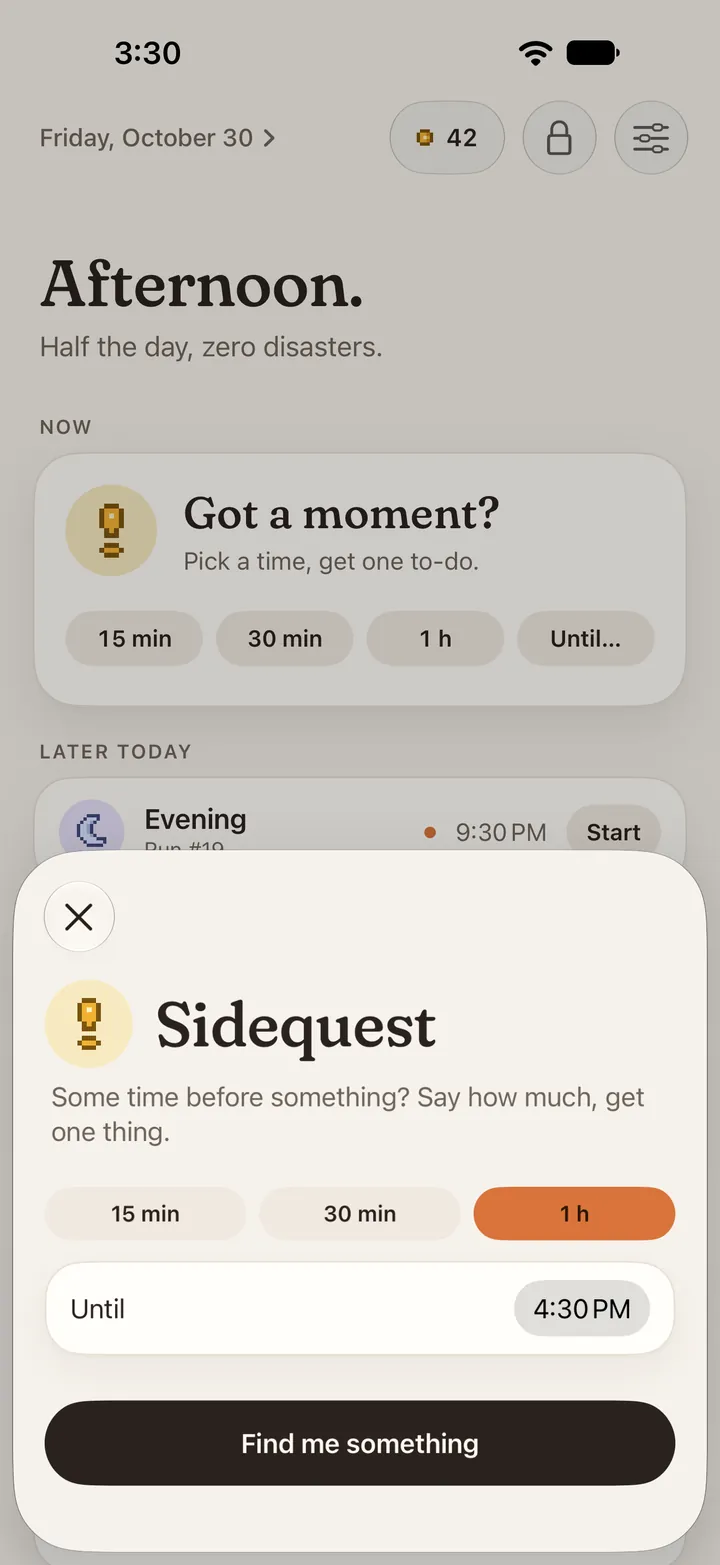
Sidequests can also be started from a widget, and with Not Yet Plus on your Apple Watch. For the if-then idea, the weekly planner lets you drop a to-do into an open slot in your week, roughly then, not a deadline. And for things you need to start every day, like getting out the door in the morning, routines break them into steps you check off one by one. The guide to an ADHD morning routine goes into that in detail, and the Not Yet home page shows the rest.
With paper, a friend or an app, the idea is the same: make the start so small and so clear that there’s nothing left to decide. Then take that one step.
Sources
- Cleveland Clinic: Feeling Stuck? Here’s How To Overcome ADHD Paralysis (2023)
- Child Mind Institute: What Is ADHD Paralysis? (reviewed 2026)
- CHADD: Getting Started on Inexplicably Tough Tasks (2025)
- Advances in Experimental Social Psychology: Gollwitzer and Sheeran, Implementation intentions and goal achievement: a meta-analysis of effects and processes (2006)
- NHS: Attention deficit hyperactivity disorder (ADHD) in adults (reviewed 2025)
- NHS: Symptoms of depression in adults (reviewed 2023)
This guide shares everyday strategies. It is not medical advice and doesn’t replace a diagnosis or treatment. If something here sounds familiar, a doctor or therapist can help.