An ADHD morning routine that still works on Thursday
For adults whose mornings start late, go sideways or end up on the phone. A short routine, a version for bad days, a checklist you can print, and what makes mornings hard in the first place.
Why ADHD mornings fall apart
If your mornings keep going wrong, it’s rarely because you don’t know what to do. Shower, dress, eat, leave. You know. The trouble is that a morning packs several things that are hard with ADHD into the first hour of the day, back to back, often on too little sleep.
Time you can’t feel
Many adults with ADHD describe it the same way: ten minutes feel like two, until suddenly you’re late. People call it time blindness. Research supports part of the picture. In a study of 104 adults with ADHD, Russell Barkley and colleagues found that they reproduced short time spans less accurately than a comparison group (Barkley et al., 2001). A 2023 review of the past ten years of studies found problems with judging and managing time in most of them, and also noted how little research on adults there still is (Mette, 2023).
What that means for your morning: the feeling “I’ve still got time” is not a reliable clock. Put a real one where you can see it from the bathroom and the kitchen.
Felt like2 min
Really10 min
A chain of small switches
A morning isn’t one task. It’s ten small ones with a switch between each: bed to bathroom, bathroom to wardrobe, wardrobe to kitchen, kitchen to door. Every switch is a moment where something else can win, and the phone usually does. The NHS lists being easily distracted or forgetful, finding it hard to manage your time and often losing things like keys or a phone among the signs of ADHD in adults. A morning asks for all of that at once.
A body clock that runs late
For some adults with ADHD, morning simply comes too early. In a Dutch study of 40 adults with ADHD, 31 reported long-standing trouble falling asleep. That group fell asleep and woke up later, and their melatonin rose later in the evening than in adults with ADHD who slept well and in a control group (van Veen et al., 2010). It was one small study, and it doesn’t describe everyone. But if your alarm regularly goes off in what feels like the middle of your night, that is worth knowing, and worth mentioning to a doctor.
None of this is a character flaw. It also explains why “just try harder” rarely helps. A routine that plans for these weak spots has a better chance.
Keep it to five steps
Long morning routines look great on paper and fall over by Thursday. Five steps are enough to get you up, dressed, fed and out. Fewer is fine.
Three rules make each step easier to start:
- One action per step. “Get ready” is a project. “Put on the clothes on the chair” is a step.
- Body before head. Start with things your hands can do half asleep. Decisions come later, or not at all.
- A number next to each step. On an ordinary morning, time each step once. Write the minutes next to it and add some buffer to the total. Now you have a clock that doesn’t depend on how time feels.
Here is a starting point. Swap the steps for your own, but keep the shape.
- Feet on the floor, glass of water. The glass is already on the nightstand, next to your medication if you take any. About 2 minutes.
- Bathroom. Wash, teeth, done. About 10 minutes.
- Get dressed. The clothes you put out last night. About 5 minutes.
- Eat or drink something. The same simple thing most days, so there’s nothing to decide. About 10 minutes.
- Bag, keys, phone. All in one spot by the door. Then out, or to your desk. About 3 minutes.
That’s about 30 minutes. If you need longer, add buffer, not steps.
A version for bad days
Some mornings you wake up late, slept badly or already feel behind. On those days a full routine turns into a list of things you didn’t do. So decide in advance what the short version is, and make it official.
A bad-day routine has three steps: water and medication, any clothes, keys and out. That’s it. It still counts as your morning routine.
This matters more than it sounds. When a routine has only one acceptable form, a bad morning breaks it, and after two bad mornings it’s easy to stop altogether. A short version keeps the thread. A study that followed how people build new habits in everyday life found that missing a single day did not materially affect the process (Lally et al., 2010). One skipped or shortened morning doesn’t cancel the others.
Do the hard step before the phone
Every routine has one step you skip most. For many people it’s the shower, for others it’s breakfast. Find yours and put it before the phone, not after.
The phone is the biggest switch of the morning. Messages, news and feeds have no natural end, and time feels even shorter there. A few ways to keep it out of the first steps:
- Charge it outside the bedroom, or at least out of reach of the bed.
- If it’s your alarm, put it where you have to stand up to turn it off.
- Pick the step after which the phone is allowed, say after getting dressed, and write it on a sticky note on the phone itself.
The same idea helps with starting. Make the first steps visible before you go to bed: the glass on the nightstand, the clothes on the chair, the keys by the door. In an ADDitude reader roundup, one adult with ADHD credits two things for getting to work on time: clothes ready the night before, and no social media in the morning. CHADD’s Attention magazine suggests a checklist by the door and some buffer time as ways to work with time blindness. A morning you can see is easier to start than one you have to remember.
When it gets boring, change the order, not the steps
A new routine often goes well for a week or two. Then the novelty wears off, the steps start to feel like a chore, and the whole thing quietly stops. That pattern is common: research has linked a tendency to get bored easily with more ADHD symptoms in adults (Malkovsky et al., 2012).
The answer isn’t more discipline. It’s variation that doesn’t cost you the routine. Keep the steps and change the game around them:
- Roll a die to pick the next step. Only the first and the last stay fixed.
- Save the longest step for last and make it the boss. Every step before it is a hit.
- Draw cards. Write each step on an index card, shuffle, draw.
- Change the soundtrack. One album per week, one song per step.
- Guess first. Before a step, guess how long it will take. Then check.
More on why routines wear thin, and how to keep one anyway: why routines get boring with ADHD.
An ADHD morning routine checklist for adults
Print it, copy it onto a card or tape it next to the door. The evening half is short on purpose. It does most of the deciding for the morning.
The evening before
- Clothes for tomorrow on the chair
- A glass of water on the nightstand, medication next to it if you take any
- Keys, wallet and bag in one spot by the door
- Phone charging out of reach of the bed
- The time you need to leave, on a note by the door
The morning
- Feet on the floor, water, medication
- Wash and brush your teeth
- Get dressed
- Eat or drink something simple
- Bag, keys, phone, out the door
Bad day: only steps 1, 3 and 5. That counts.
Checking it off without opening an app
A paper checklist works, and for many people it’s enough. A pencil on a string by the door, a whiteboard in the hallway. Crossing something off by hand feels good, and first thing in the morning that is worth a lot.
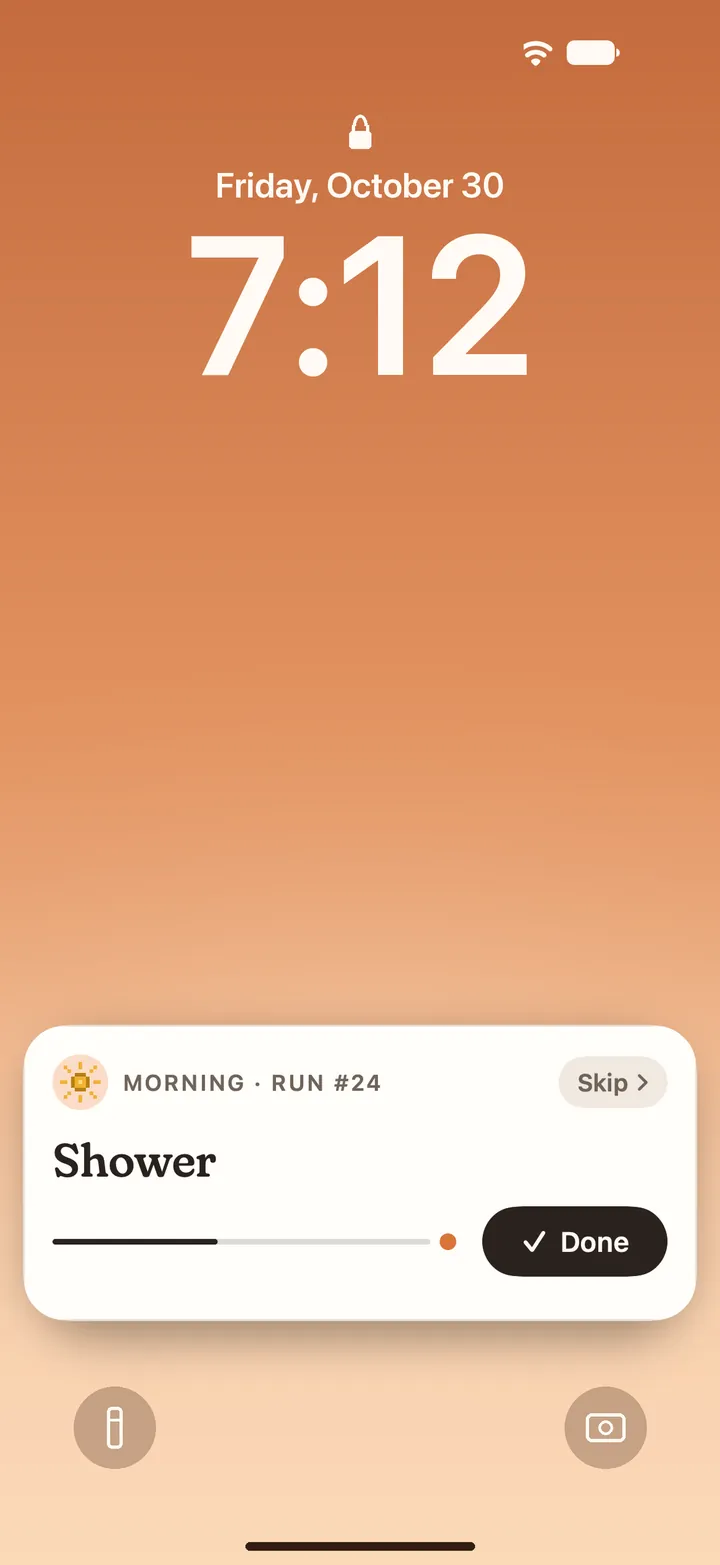
If you’d rather use your phone, the risk is the phone itself. You open an app to tick a box, and twenty minutes later you’re somewhere else entirely. That is the problem we built the routines in Not Yet around. At its time, your morning routine shows up on the Lock Screen with the current step and a Done button, so you can check it off without opening anything. It also doesn’t stay the same: every few runs, the way it plays changes, from Wheel or Dice order, which pick the next step, to Boss fight, where the longest step comes last. After a few days away, the first run back is a short one, and nothing mentions the gap.
If getting up is the hard part, the alarm rings even on silent, has no snooze and only goes quiet after a short wake-up task, like three sums or 30 steps. Your morning routine can start as soon as the task is done. For more on that first minute, see what helps when you can’t wake up to alarms.
When it’s more than a rough morning
A routine can make mornings easier. It can’t fix what’s underneath if something else is going on. Talk to a doctor if you’re tired most days despite enough time in bed, if trouble sleeping has lasted for weeks, if your mood has been low for a while, or if you think you might have ADHD and it affects your work, studies or relationships. The NHS also notes that people with ADHD may be more likely to have anxiety or depression. You don’t need a diagnosis to use anything in this guide, and nothing here replaces one.
Sources
- NHS: ADHD in adults (2025)
- Barkley, Murphy, Bush: Time perception and reproduction in young adults with attention deficit hyperactivity disorder. Neuropsychology 15(3) (2001)
- Mette: Time Perception in Adult ADHD: Findings from a Decade. A Review. International Journal of Environmental Research and Public Health 20(4) (2023)
- van Veen, Kooij, Boonstra, Gordijn, van Someren: Delayed circadian rhythm in adults with attention-deficit/hyperactivity disorder and chronic sleep-onset insomnia. Biological Psychiatry 67(11) (2010)
- Lally, van Jaarsveld, Potts, Wardle: How are habits formed: Modelling habit formation in the real world. European Journal of Social Psychology 40(6) (2010)
- Malkovsky, Merrifield, Goldberg, Danckert: Exploring the relationship between boredom and sustained attention. Experimental Brain Research 221(1) (2012)
- CHADD, Attention magazine: Time Unbound: Managing Time Blindness at Work (2024)
- ADDitude: “What Is Your Most Reliable, Helpful Daily Routine?” (reader experiences) (2025)
This guide shares everyday strategies. It is not medical advice and doesn’t replace a diagnosis or treatment. If something here sounds familiar, a doctor or therapist can help.