Sleeping through your alarm: why it happens and what helps
For anyone who sleeps through alarms, snoozes for an hour or turns the alarm off without remembering it. What’s behind it, when it’s worth seeing a doctor, and what you can change tonight.
One tap
Rings, snooze, back to sleep. Nine minutes, then again, until it’s an hour you never decided on.
A task first
Rings, three sums or 30 steps, and by the time it’s quiet, you’re already up.
Why you can’t wake up to alarms
“I didn’t hear it” is usually only half the story. The alarm rang. Something between the sound and getting up didn’t work. That something tends to be one of five things, and it helps to know which one is yours.
Too little sleep, or sleep at the wrong time
The most common reason is the plainest: the alarm rings before your body is done. If you regularly sleep six hours and need eight, every alarm is fighting a deficit. The same happens when you sleep enough hours, just too late. An alarm at 6:30 lands in the middle of the night for a body clock that is still set to 4:00.
Sleep inertia: awake, but not yet online
The first minutes after waking have a name: sleep inertia. Researchers describe it as temporary sleepiness, disorientation and slower thinking on waking. A 2019 review found that performance often recovers within about 30 minutes, while full recovery can take an hour or more. Sleep inertia is stronger after short nights and when you wake during your biological night. So the people who most need to get up quickly are often the ones who feel it most.
How clear your head is
The tone stopped being news
The same sound at the same time every morning becomes familiar. Many people notice that an alarm that used to jolt them awake fades into the background after a few weeks. A new tone often works again for a while, and then the cycle starts over.
You turned it off and don’t remember
This one is unsettling the first time: the phone says the alarm was stopped, and you have no memory of it. Sleep inertia helps explain it. The same review describes the prefrontal regions, which handle planning and decisions, as the slowest to return to normal after waking. Tapping a familiar button needs almost nothing from them. Your hand knows the move. The rest of you isn’t there yet.
A body clock that runs late
Some people are simply set late. When it’s strong and persistent, doctors call it delayed sleep phase disorder: people consistently fall asleep and wake up late, and cannot fall asleep earlier even if they try. For them, an early alarm isn’t a discipline problem. It’s a timing problem.
Why mornings are often harder with ADHD
If you have ADHD and mornings are a daily fight, you’re far from alone, and there’s a physical reason worth knowing about. In a Dutch study, 31 of 40 adults with ADHD reported long-standing trouble falling asleep. In that group, the evening rise of melatonin, the body’s signal that night is starting, came later than in adults without ADHD, and their sleep was shifted later too.
A 2019 review puts delayed sleep phase at 73 to 78 percent of children and adults with ADHD. Its authors suggest that part of what looks like ADHD symptoms may come from chronic sleep problems, and that this group should get help with their sleep in addition to their ADHD treatment. The studies are small, but the direction is consistent.
Two more things make many ADHD mornings harder. Transitions are hard, and getting out of a warm bed is the first one of the day. And evenings tend to stretch: when the day finally gets quiet, it’s tempting to keep it going, which pushes sleep later still.
None of this means you can’t get up. It means that willpower at 6:30 is the wrong tool. The better tools are set up the evening before, and they work by needing as little of you as possible in the first minute.
What snoozing does, and doesn’t do
Snoozing is extremely common. In an analysis of about 3 million nights from roughly 21,000 people worldwide, more than half of all sleep sessions ended with a snooze. About 45 percent of people snoozed on more than 80 percent of mornings, for around 20 minutes a day (Mass General Brigham, 2025). In a smaller study of 450 working adults, 57 percent were snoozers. Being younger, more of an evening type and having more disturbed sleep made snoozing more likely.
Is it bad for you? The honest answer: not clearly. In a Swedish sleep-lab study, 31 regular snoozers who were allowed 30 minutes of snoozing barely lost any total sleep. They did slightly better on thinking tests right after waking and showed no clear effect on mood or sleepiness. The researchers stress that this applies to regular snoozers who fall back asleep easily, not to everyone. Other sleep researchers point out that the last hours before waking are rich in REM sleep, which snoozing breaks up. Their advice: set the alarm for the latest possible time and get up when it first rings.
So the problem with snooze is less what it does to your brain and more what it does to your morning. One snooze is a choice. Six of them, made half asleep, aren’t. And if you need half an hour of snoozing every day, it’s often a sign that you need more sleep, or that your sleep starts too late.
When to talk to a doctor
Sleeping through alarms is usually about habits and timing. Sometimes it isn’t. The NHS advises seeing a doctor if:
- you’ve been tired for a few weeks and don’t know why, or the tiredness affects your daily life;
- you always feel very tired during the day;
- someone notices that your breathing stops and starts while you sleep, or that you make gasping, snorting or choking noises;
- you snore loudly, wake up a lot or often have a headache when you wake up.
The last two can be signs of sleep apnoea, which a doctor can check for. Stress, depression, and some illnesses and treatments can also make mornings much heavier. If you have ADHD and your sleep runs late night after night, mention it to whoever treats your ADHD. Sleep can be looked at in its own right.
What helps, without any app
Start here. These steps take a few minutes to set up, and they make any alarm work better.
Keep the wake-up time steady
The NHS advice for better sleep starts in the morning: wake up and get out of bed at the same time every day, and don’t sleep in after a bad night. Sleeping until noon on Sunday makes Monday’s alarm land even deeper in your biological night. If weekends have to be different, keep them close.
Fix the night before, not just the morning
Most hard mornings start the evening before. Count back from your alarm: if you need to be up at 7:00 and need about eight hours, lights out is around 23:00, not whenever the feed runs out. The NHS also suggests relaxing for an hour before bed and not using your phone right before sleep. If your evenings are where it slips, our guide to scrolling in bed goes into that part.
One alarm, not five
A ladder of alarms (6:00, 6:10, 6:20 …) teaches you that the first ones don’t count. Set one alarm, at the latest time that still works, and treat it as the real one. That’s also the advice of the researchers behind the large snooze study.
Turn off snooze on iPhone
In Apple’s Clock app, snooze is a switch on each alarm (Apple Support):
- Open Clock and tap Alarms.
- Tap the alarm time.
- Turn off Snooze and confirm.
Repeat it for every alarm. The Clock alarm rings in silent mode and with a Focus on. Its volume lives in Settings › Sounds & Haptics, so check that it isn’t turned all the way down.
Put the alarm out of reach
If you can stop it without moving, you will. Put the phone or alarm clock across the room, so stopping it means standing up. It’s the oldest trick there is, and it works for the same reason as everything else here: by the time the alarm is off, you’re out of bed. Its weak spot is just as well known. You walk over, stop it and walk back to bed.
Get light soon after you’re up
Light won’t switch off the grogginess right away. In the studies the 2019 review looked at, light after waking did little against sleep inertia. Its value is longer term: for people with a late body clock, bright light within four hours of waking may help. How well light therapy shifts sleep is still debated, and the studies so far are small. Open the curtains, have breakfast by the window or step outside for a few minutes. It’s easy and it can’t hurt.
Decide the first two minutes the night before
A foggy head is bad at decisions, so make them the evening before. Where your clothes are. What you do first: water, bathroom, light. What you don’t do: open the feed in bed. The fewer choices in the first minutes, the less there is to negotiate. A short morning routine carries you from there.
Change the sound now and then
If you notice you’ve stopped hearing your alarm, pick a new tone. Many people find a new sound works again, at least for a while.
Put a task between you and the off button
All of the above has the same weak point: the off button. As long as one tap ends the alarm, the half-asleep you can tap it. The fix is to make stopping the alarm require something your brain can’t do on autopilot: a few sums, a few steps, a walk to another room.
Without an app, that can be as simple as an alarm clock in the hallway. On a phone, it’s what alarm apps with tasks are for. Not Yet has one built in, made for exactly the moment when a familiar tone gets snoozed with the side button without a second thought. Here’s what it does:
- It rings even on silent and through any Focus, using Apple’s AlarmKit, with a different tone each time.
- There’s no snooze. Stop it, and it rings again a few seconds later, until the wake-up task is done.
- The task is short and picked at random: three quick sums, numbers in order, a minute of shaking, 30 steps to the kitchen and back, or scanning an NFC tag. You choose which kinds can come up, and you only find out which one when it rings.
- An NFC tag in the bathroom is the firmest option. Stick it by the sink, and the alarm only goes quiet once you’re standing there. NFC tags are part of Plus.
- It can end the night, too. If Bedtime lock keeps your apps locked overnight, the finished wake-up task unlocks them, so you’re up before the feed opens. Bedtime lock is part of Plus.
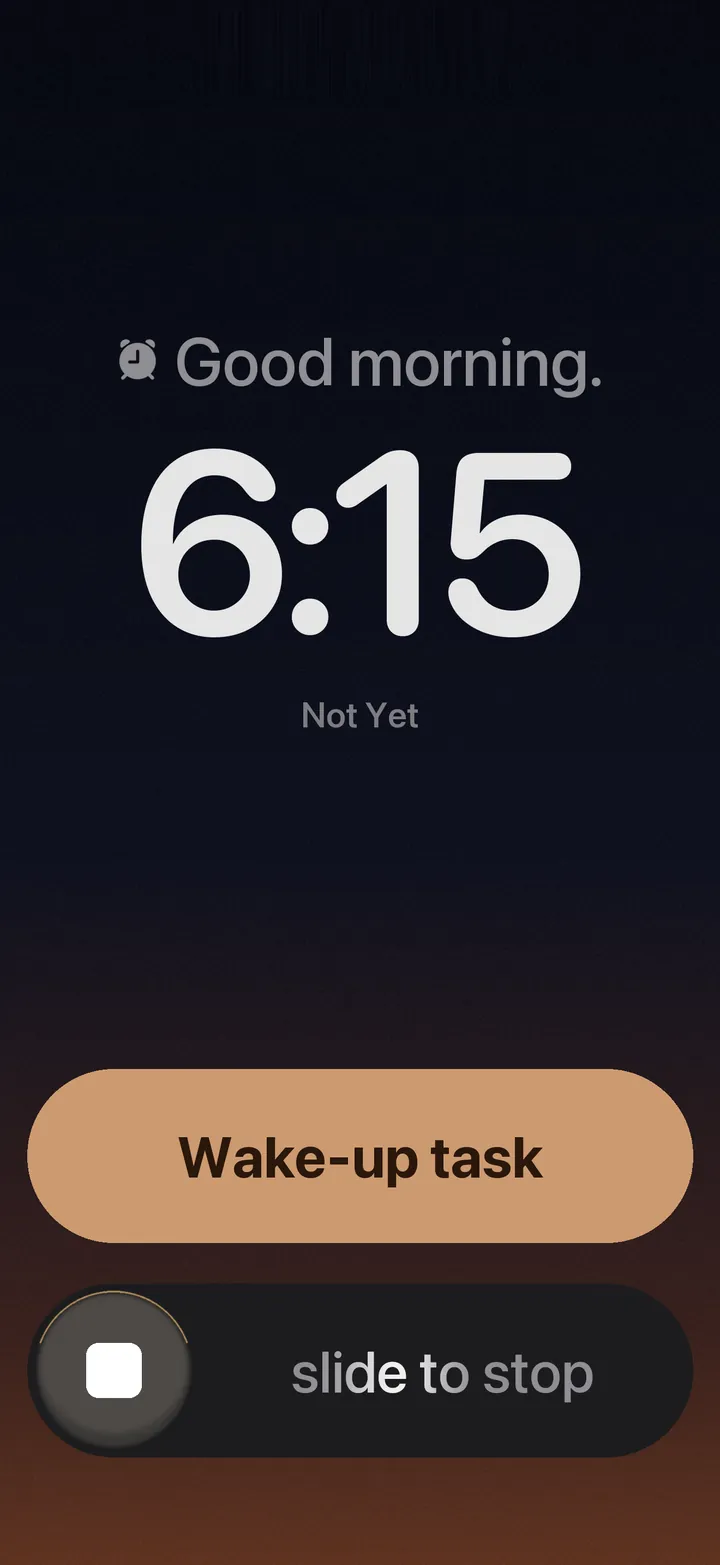
If nobody does the task, the alarm gives up after an hour. More on the alarm clock with tasks, on locking apps until you’re up and on planning your nights.
A plan for next week
Don’t change everything at once. Pick the steps that match your causes:
- For one week, write down when you fall asleep, when the alarm rings and when you actually get up.
- Choose one wake-up time for workdays and keep weekends close to it.
- Count back the sleep you need and set a time for lights out.
- Turn off snooze and delete the backup alarms. One alarm, at the real time.
- Put the alarm out of reach, or make it ask for a task.
- Before bed, lay out what you need for the first two minutes.
- Open the curtains or step outside soon after getting up.
- Still very tired after a few weeks of enough sleep? Talk to a doctor.
Some mornings will still go wrong. That’s no reason to start over. Tomorrow’s alarm is a new one.
Sources
- NHS: Sleep apnoea
- NHS: Tiredness and fatigue
- NHS: Insomnia
- Hilditch & McHill: Sleep inertia: current insights. Nature and Science of Sleep (2019)
- Mattingly et al.: Snoozing: an examination of a common method of waking. Sleep (2022)
- Stockholm University: You don’t lose if you snooze (2023), on Sundelin, Landry & Axelsson, Journal of Sleep Research
- Mass General Brigham: Don’t hit snooze on new research about waking up each morning (2025), on Robbins et al., Scientific Reports
- Van Veen et al.: Delayed circadian rhythm in adults with ADHD and chronic sleep-onset insomnia. Biological Psychiatry (2010)
- Bijlenga et al.: The role of the circadian system in the etiology and pathophysiology of ADHD: time to redefine ADHD? ADHD Attention Deficit and Hyperactivity Disorders (2019)
- MSD Manual Consumer Version: Circadian rhythm sleep disorders (2026)
- Gomes et al.: Light therapy for the treatment of delayed sleep-wake phase disorder in adults: a systematic review. Sleep Science (2021)
- Apple Support: Set an alarm in Clock on iPhone
This guide shares everyday strategies. It is not medical advice and doesn’t replace a diagnosis or treatment. If something here sounds familiar, a doctor or therapist can help.