ADHD procrastination: why you put things off, and how to break the loop
For anyone with a task that has sat on the list for weeks while everything else got done. What research says about why ADHD and procrastination go together, and seven ways out of the avoidance loop.
The avoidance loop
A way out
-
The task
An email, a form, a call.
Make it lighter
-
A bad feeling
Unsure, bored, afraid of the answer.
Name it
-
The detour
The phone, a snack, another chore.
Add a step
-
Relief
It works, for now. That’s the reward.
-
Still there
A bit later, a bit bigger, plus guilt.
Next time, the feeling is stronger
The task that has been waiting for three weeks
An email you need to answer. An official form. A call to book an appointment. A parcel that has to go back. None of it is hard, and none of it takes long. Still, it has been on your list for three weeks.
In the meantime you have done plenty. Washed the dishes, sorted a drawer, watched a whole season of something. Every day the task gets a little heavier. So you think about it less.
That is procrastination. The psychologist Russell Ramsay, who specialises in adult ADHD, describes it as “putting off tasks despite knowing you will be worse off as a consequence.” Knowing isn’t the problem. Something else is in the way.
Procrastination or task paralysis?
The two get mixed up, and they call for different help.
- Task paralysis is when you want to start and can’t. You sit in front of the task, and nothing happens. You don’t do anything else either. You’re stuck.
- Procrastination is when you do something else instead. Usually something more pleasant, often something that looks useful. You promise yourself “later”, and the task waits.
Paralysis is a frozen engine, procrastination a detour you keep taking. Both can show up together, but this guide is about the detour.
Is procrastination an ADHD symptom?
Not officially. Procrastination isn’t on the list of diagnostic criteria. Researchers at Radboud University note exactly that, and also that it is often part of therapy for adults with ADHD. In their small study of 54 students, only one symptom area was linked to general procrastination once the others were taken into account: inattention, not impulsivity.
Larger studies find a link as well. In a survey of 490 adults in Japan, those who scored above the cut-off on an ADHD screening questionnaire reported clearly more procrastination than the rest, a large difference. Keep the limits in mind: it was all self-report, the screening tool is not a diagnosis, and one of its questions is close to procrastination itself. A preregistered study with 640 adults, published in 2026, also found that symptoms of inattention went along with more procrastination.
The other direction matters too: almost everyone procrastinates sometimes, and putting things off doesn’t mean you have ADHD. If it is costing you at work, with money or with your health, or it comes with low mood, talk to your doctor. An ADHD assessment can be part of that conversation.
Why ADHD procrastination happens
There isn’t one cause. Three threads come up again and again in the research.
It’s about feelings first
Procrastination looks like a time problem, but researchers increasingly see it as a mood problem. In an influential review, the psychologists Fuschia Sirois and Timothy Pychyl describe it as putting short-term mood repair ahead of long-term goals. Avoiding the task makes you feel better now. The cost lands on your future self, and your future self isn’t here yet.
That matters with ADHD, because feelings tend to run stronger. A meta-analysis of 13 studies with 2,535 participants found that adults with ADHD had much more difficulty regulating emotions than adults without ADHD, a large difference. And in a study of 595 college students, difficulties with emotion regulation and lower self-esteem partly explained why more ADHD symptoms went along with more procrastination.
So the email isn’t avoided because it’s long. It’s avoided because opening it means feeling something: unsure, judged, bored, behind.
Reward now beats reward later
The second thread is timing. A meta-analysis of 37 comparisons with 3,763 participants found that people with ADHD chose a small reward now over a bigger one later more often than people without ADHD. The effects were small to medium, but they point in one direction.
Two studies by Ruth Netzer Turgeman and Yehuda Pollak looked more closely at procrastination itself. In one, with 202 adults, impulsiveness and a lower expectation of getting the task done well partly explained the link between ADHD symptoms and procrastination. In the larger 2026 study, being sensitive to delay and seeing little value in the task were among the factors that did.
An official form pays off in a few weeks, maybe. The video next to it pays off in a second.
Some tasks are simply unpleasant
The third thread is the task itself. In a large meta-analysis of 691 correlations, Piers Steel found that how unpleasant a task feels is one of the most consistent predictors of procrastination, for everyone. The same goes for how far away the reward or the deadline is.
In the 202-person study, people with more ADHD symptoms also rated tasks as more unpleasant, although in that study it wasn’t one of the factors that explained the link. The takeaway is practical: if a task feels unpleasant, that is something you can work on, not just something you have to push through.
The avoidance loop
Put the three threads together, and you get a loop that feeds itself:
- You think of the task, and it brings up an unpleasant feeling.
- You switch to something nicer: the phone, a snack, a different chore.
- The feeling eases. That relief is the reward, and it teaches your brain that switching works.
- The task is still there, now a bit later, a bit bigger, with a bit of guilt attached.
- Next time, the feeling is stronger. Back to step one.
Research shows both halves of the trade. In two classic studies by Dianne Tice and Roy Baumeister, students who procrastinated reported less stress and fewer illnesses early in the semester. By the end, the picture had flipped: more stress, more illness, and lower grades on all their assignments. And a study led by Marcus Eckert found that procrastination predicted a lower ability to tolerate unpleasant feelings later on. The loop doesn’t just repeat. It gets tighter.
Stress
Start of termEnd of term
It also has a sneaky version. Ramsay calls it “procrastivity”: putting off the task that matters most by escaping into one that matters less but still gets something done. You clean the kitchen, reply to every other email, reorganise your files. It feels productive, and it is still the detour.
How to stop procrastinating with ADHD: 7 ways out of the loop
The aim isn’t more willpower. It’s to change the trade: make the task less unpleasant, the reward closer, and the detour less automatic.
1. Name the feeling, not the task
Ask yourself: what exactly don’t I want to feel? Bored? Afraid of the answer? Unsure what the first step even is? Say it in one sentence. A named feeling is easier to sit with than a vague dread. In Eckert’s third study, a randomised trial, training people to tolerate and change unpleasant feelings reduced procrastination. That study wasn’t about ADHD, but the idea is simple to try: stay with the feeling for a minute without fleeing, then open the task.
2. Change the task until it’s less unpleasant
The feeling you named tells you what to change.
- Boring: pair it with something. A playlist, a podcast, a café instead of your desk.
- Unclear: rewrite it as a concrete action. Not “sort out insurance” but “find the letter with the policy number”.
- Scary: lower the stakes. Write a deliberately rough first draft of the email, or do it next to someone you trust.
3. Put the reward into the doing
“You’ll feel so relieved when it’s done” is a reward later, and later loses. In five studies, Kaitlin Woolley and Ayelet Fishbach found that immediate rewards predicted whether people stuck with long-term goals better than delayed rewards did. Make the task pay while you’re doing it: your favourite drink only during paperwork, a tally mark or a coin in a jar for each piece, music you only play for this.
4. Give “later” an address
“Later” is not a time. Turn it into an if-then plan: “If I sit down with my coffee after lunch, then I open the form.” In a meta-analysis of 94 tests, plans like this had a medium-to-large effect on reaching goals, and they helped people get started and stay on track despite distractions. Tie the task to something that happens anyway.
5. Make your escape route a little harder
Most detours run the same way: the same app, the same chore, the same snack. You don’t have to remove them, just add a step. Phone in another room for twenty minutes, the app logged out, the TV remote in a drawer. A few seconds of friction is often enough to notice that you’re about to take the detour again.
6. Forgive yesterday’s delay
Self-criticism feels like taking it seriously. In practice, it adds to the very feeling the loop runs on. In a study with 134 first-year students, those who forgave themselves for procrastinating before their first exams felt less bad afterwards and procrastinated less before the next ones. Try saying it plainly: “I put it off. That happens. Today I’ll do the first part.”
7. Get support when it’s more than a habit
If procrastination keeps getting in the way of work, money or relationships, you don’t have to fix it alone. The NHS notes that talking therapies such as cognitive behavioural therapy (CBT) may be recommended for adults with ADHD, and lists help from another person to plan and structure your tasks among possible adjustments at work. Your doctor is a good place to start.
- Pick one task you’ve been putting off. Just one.
- Write down the feeling it brings up, in one sentence.
- Change one thing about the task to match: more fun, clearer, or lower stakes.
- Choose a reward you get while doing it, not after.
- Write your if-then plan: “If …, then I start.”
- Add one step of friction to your usual detour.
- If it slips anyway, forgive it, and pick a new “if”.
Where an app can help
All of this works with paper, a jar and a timer. Where it often breaks down with ADHD is the reward part: it has to be there every time, right away, without you organising it. Not Yet, an iPhone and Apple Watch app built with ADHD in mind, is designed around that.
- Rewards in the doing. In a routine, every step you check off earns coins on the spot, and at the end of the run they sit in a piggy bank you get to smash. Even a run you end early can still give you a small piggy, “for getting started.”
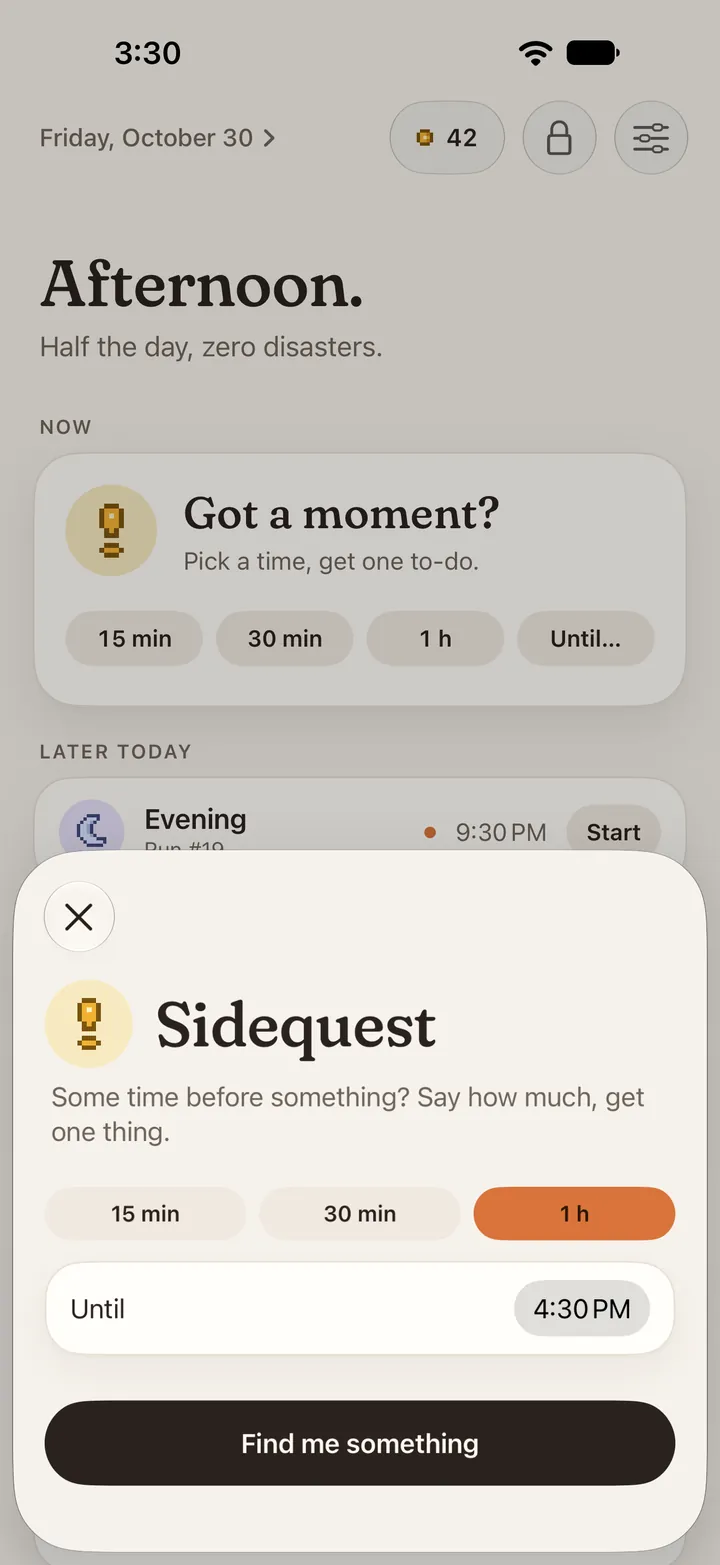
- No choosing. Choosing which task to do is a classic detour. With a Sidequest, you say how much time you have (15 min, 30 min, an hour, or until a set time), turn over a card and get one to-do that fits. Not that one? Tap “Something else”. Done it? Tap “Did it” and collect your coins.
- A harder detour. With Coin lock, the apps you usually escape into stay locked and open only with coins, 1 coin per minute. Coins can’t be bought, only earned by doing things. The basics cover two apps, Plus covers as many as you like.
If your evenings are where the loop is strongest, the guide on how to stop scrolling at night looks at its bedtime version. The Not Yet home page shows the rest of the app.
With or without an app, the goal is the same: a task that feels a little less unpleasant, a reward that comes a little sooner, and a detour that takes a little more effort.
Sources
- Psychology Today: Ramsay, Procrastivity (a.k.a. Sneaky Avoidance) and Adult ADHD Coping (2020)
- International Journal of Methods in Psychiatric Research: Niermann and Scheres, The relation between procrastination and symptoms of ADHD in undergraduate students (2014)
- Frontiers in Psychology: Oguchi et al., The Moderating Effect of Attention-Deficit Hyperactivity Disorder Symptoms on the Relationship Between Procrastination and Internalizing Symptoms in the General Adult Population (2021)
- Journal of Attention Disorders: Netzer Turgeman and Pollak, What Are You Waiting For?! Roles of Motivation, Goal Orientation, and Emotion Regulation in Explaining the Link Between ADHD and Procrastination (2026)
- Australian Psychologist: Netzer Turgeman and Pollak, Using the temporal motivation theory to explain the relation between ADHD and procrastination (2023)
- Social and Personality Psychology Compass: Sirois and Pychyl, Procrastination and the Priority of Short-Term Mood Regulation: Consequences for Future Self (2013)
- BMC Psychiatry: Beheshti et al., Emotion dysregulation in adults with ADHD: a meta-analysis (2020)
- Journal of Psychopathology and Behavioral Assessment: Bodalski et al., ADHD Symptoms and Procrastination in College Students: The Roles of Emotion Dysregulation and Self-Esteem (2022)
- Journal of Attention Disorders: Marx et al., ADHD and the Choice of Small Immediate Over Larger Delayed Rewards: A Comparative Meta-Analysis (2021)
- Psychological Bulletin: Steel, The nature of procrastination: a meta-analytic and theoretical review (2007)
- Psychological Science: Tice and Baumeister, Longitudinal Study of Procrastination, Performance, Stress, and Health: The Costs and Benefits of Dawdling (1997)
- Learning and Individual Differences: Eckert et al., Overcome procrastination: Enhancing emotion regulation skills reduce procrastination (2016)
- Personality and Social Psychology Bulletin: Woolley and Fishbach, Immediate Rewards Predict Adherence to Long-Term Goals (2017)
- Advances in Experimental Social Psychology: Gollwitzer and Sheeran, Implementation intentions and goal achievement: a meta-analysis of effects and processes (2006)
- Personality and Individual Differences: Wohl, Pychyl and Bennett, I forgive myself, now I can study: How self-forgiveness for procrastinating can reduce future procrastination (2010)
- NHS: Attention deficit hyperactivity disorder (ADHD) in adults (reviewed 2025)
This guide shares everyday strategies. It is not medical advice and doesn’t replace a diagnosis or treatment. If something here sounds familiar, a doctor or therapist can help.